what company was the first to sell a usb flash drive

A SanDisk Cruzer USB drive from 2011, with 4 GB of storage capacity
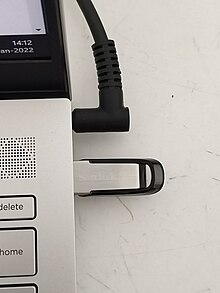
A SanDisk Ultra Flair USB bulldoze from 2020, fastened with an HP Laptop
A USB flash drive (also called a thumb drive)[1] [note i] is a data storage device that includes wink memory with an integrated USB interface. It is typically removable, rewritable and much smaller than an optical disc. Most weigh less than 30 g (1 oz). Since first appearing on the market in late 2000, equally with well-nigh all other computer memory devices, storage capacities have risen while prices have dropped. Every bit of March 2016[update], flash drives with anywhere from viii to 256 gigabytes (GB[4]) were frequently sold, while 512 GB and 1 terabyte (TB[5]) units were less frequent.[6] [7] Every bit of 2018, 2 TB flash drives were the largest available in terms of storage capacity.[8] Some allow upwards to 100,000 write/erase cycles, depending on the exact blazon of retention bit used, and are thought to physically terminal betwixt 10 and 100 years under normal circumstances (shelf storage time[9]).
Common uses of USB flash drives are for storage, supplementary back-ups, and transferring of computer files. Compared with floppy disks or CDs, they are smaller, faster, have significantly more chapters, and are more durable due to a lack of moving parts. Additionally, they are less vulnerable to electromagnetic interference than floppy disks, and are unharmed past surface scratches (unlike CDs). However, as with any wink storage, information loss from bit leaking due to prolonged lack of electrical power and the possibility of spontaneous controller failure due to poor manufacturing could brand it unsuitable for long-term archival of data. The power to retain data is affected by the controller'due south firmware, internal data redundancy, and error correction algorithms.[ten] [11]
Until about 2005, most desktop and laptop computers were supplied with floppy disk drives in improver to USB ports, merely floppy disk drives became obsolete after widespread adoption of USB ports and the larger USB drive chapters compared to the "ane.44 megabyte" (1440 kibibyte) 3.5-inch floppy disk.
USB flash drives employ the USB mass storage device course standard, supported natively by modern operating systems such as Windows, Linux, macOS and other Unix-like systems, as well as many BIOS boot ROMs. USB drives with USB ii.0 back up can shop more data and transfer faster than much larger optical disc drives like CD-RW or DVD-RW drives and can be read past many other systems such equally the Xbox One, PlayStation four, DVD players, auto amusement systems, and in a number of handheld devices such equally smartphones and tablet computers, though the electronically similar SD carte du jour is ameliorate suited for those devices, due to their standardized form gene, which allows it to be housed inside a device without protruding.
A wink drive consists of a small printed circuit board conveying the circuit elements and a USB connector, insulated electrically and protected within a plastic, metal, or rubberized case, which can exist carried in a pocket or on a fundamental chain, for case. Some are equipped with an I/O indication LED that lights up or blinks upon access. The USB connector may be protected by a removable cap or by retracting into the body of the drive, although it is not likely to exist damaged if unprotected. Virtually wink drives use a standard blazon-A USB connexion allowing connection with a port on a personal reckoner, but drives for other interfaces also exist (e.g. micro-USB and USB-C ports). USB wink drives describe power from the computer via the USB connection. Some devices combine the functionality of a portable media actor with USB wink storage; they require a battery only when used to play music on the get.
History [edit]
The ground for USB wink drives is wink retentiveness, a type of floating-gate semiconductor memory invented by Fujio Masuoka in the early 1980s. Flash memory uses floating-gate MOSFET transistors as memory cells.[12] [13]
Multiple individuals have staked a claim to being the inventor of the USB flash drive. On Apr v, 1999, Amir Ban, Dov Moran, and Oron Ogdan of Chiliad-Systems, an Israeli company, filed a patent application entitled "Architecture for a Universal Serial Bus-Based PC Flash Disk".[14] [3] The patent was subsequently granted on Nov 14, 2000 and these individuals have often been recognized as the inventors of the USB flash drive.[15] Also in 1999, Shimon Shmueli, an engineer at IBM, submitted an invention disclosure asserting that he had invented the USB wink drive.[iii] [16] A Singaporean company named Expedition 2000 International is the get-go visitor known to have sold a USB flash drive, and has as well maintained that it is the original inventor of the device.[17] Finally Pua Khein-Seng, a Malaysian engineer, has as well been recognized by some equally a possible inventor of the device.[xviii]
Given these competing claims to inventorship, patent disputes involving the USB flash drive have arisen over the years. Both Trek 2000 International and Netac Technology take accused others of infringing their patents on the USB wink drive.[xix] [xx] [21] However, despite these lawsuits, the question of who was the starting time to invent the USB flash drive has not been definitively settled and multiple claims persist.
Technology improvements [edit]
Flash drives are often measured by the rate at which they transfer data. Transfer rates may be given in megabytes per second (MB/s), megabits per second (Mbit/s), or in optical drive multipliers such as "180X" (180 times 150 KiB/s).[22] File transfer rates vary considerably amid devices. 2d generation wink drives have claimed to read at up to 30 MB/s and write at nigh one-half that rate, which was about 20 times faster than the theoretical transfer rate achievable past the previous model, USB i.1, which is limited to 12 Mbit/southward (1.5 MB/southward) with deemed overhead.[23] The effective transfer rate of a device is significantly affected by the information admission pattern.[24]
By 2002, USB flash drives had USB two.0 connectivity, which has 480 Mbit/s as the transfer rate upper bound; later on bookkeeping for the protocol overhead that translates to a 35 MB/s effective throughput.[25] That aforementioned year, Intel sparked widespread use of second generation USB by including them within its laptops.[26]
By 2010, the maximum available storage capacity for the devices had reached upwards of 128 GB.[27] USB iii.0 was slow to announced in laptops. Through 2010, the bulk of laptop models even so contained just USB two.0.[26]
In January 2013, tech company Kingston, released a wink drive with one TB of storage.[28] The first USB 3.1 blazon-C flash drives, with read/write speeds of around 530 MB/s, were announced in March 2015.[29] Past July 2016, flash drives with viii to 256 GB capacity were sold more than oft than those with capacities betwixt 512 GB and 1 TB.[half-dozen] [7] In 2017, Kingston Applied science announced the release of a 2-TB wink drive.[30] In 2018, SanDisk appear a 1TB USB-C wink drive, the smallest of its kind.[31]
| | |
| one | USB Standard-A, "male person" plug |
|---|---|
| 2 | USB mass storage controller device |
| 3 | Test point |
| 4 | Flash retentiveness fleck |
| 5 | Crystal oscillator |
| 6 | LED (Optional) |
| 7 | Write-protect switch (Optional) |
| 8 | Infinite for second flash memory chip |

On a USB flash bulldoze, ane terminate of the device is fitted with a single Standard-A USB plug; some flash drives additionally offer a micro USB or USB-C plug, facilitating data transfers between different devices.[32]
Technology [edit]

On a USB wink drive, ane end of the device is fitted with a single USB plug; some flash drives additionally offer a micro USB plug, facilitating data transfers betwixt different devices.
Inside the casing is a small printed circuit lath, which has some ability circuitry and a small number of surface-mounted integrated circuits (ICs).[ citation needed ] Typically, i of these ICs provides an interface between the USB connector and the onboard memory, while the other is the flash memory. Drives typically use the USB mass storage device course to communicate with the host.[33]
Flash memory [edit]
Flash retentiveness combines a number of older technologies, with lower cost, lower power consumption and small size made possible by advances in semiconductor device fabrication technology. The memory storage was based on earlier EPROM and EEPROM technologies. These had limited chapters, were slow for both reading and writing, required complex loftier-voltage drive circuitry, and could be re-written simply subsequently erasing the entire contents of the bit.
Hardware designers later developed EEPROMs with the erasure region cleaved upwardly into smaller "fields" that could be erased individually without affecting the others. Altering the contents of a particular memory location involved copying the unabridged field into an off-flake buffer retention, erasing the field, modifying the data equally required in the buffer, and re-writing it into the same field. This required considerable computer back up, and PC-based EEPROM wink memory systems often carried their ain dedicated microprocessor system. Wink drives are more or less a miniaturized version of this.
The development of high-speed serial data interfaces such as USB made semiconductor memory systems with serially accessed storage viable, and the simultaneous evolution of small, high-speed, low-ability microprocessor systems allowed this to be incorporated into extremely compact systems. Serial admission requires far fewer electrical connections for the memory fries than does parallel access, which has simplified the manufacture of multi-gigabyte drives.
Computers access mod[update] flash retentiveness systems very much like hard disk drives, where the controller system has full control over where information is actually stored. The bodily EEPROM writing and erasure processes are, however, still very like to the before systems described above.
Many depression-cost MP3 players but add extra software and a battery to a standard flash retentiveness control microprocessor so information technology tin can also serve equally a music playback decoder. Almost of these players can likewise be used as a conventional flash drive, for storing files of whatever type.
Essential components [edit]

The internal mechanical and electronic parts of a Kingston ii GB flash bulldoze
In that location are typically five parts to a flash drive:
- USB plug – provides a physical interface to the host figurer. Some USB flash drives use USB plug that does not protect the contacts, with the possibility of plugging information technology into the USB port in the wrong orientation, if the connector blazon is not symmetrical.
- USB mass storage controller – a small microcontroller with a small amount of on-flake ROM and RAM.
- NAND flash memory fleck(s) – stores data (NAND wink is typically also used in digital cameras).
- Crystal oscillator – produces the device'due south main clock signal and controls the device'due south data output through a stage-locked loop.
- Comprehend – typically made of plastic or metal, protecting the electronics against mechanical stress and even possible curt circuits.
Additional components [edit]
The typical device may also include:
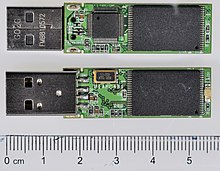
The front and rear side of a USB wink drive with the casing removed
- Jumpers and test pins – for testing during the flash drive'southward manufacturing or loading code into its microcontroller.
- LEDs – point data transfers or data reads and writes.
- Write-protect switches – Enable or disable writing of data into memory.
- Unpopulated space – provides space to include a second memory chip. Having this 2nd space allows the manufacturer to use a unmarried printed circuit lath for more than one storage size device.
- USB connector cover or cap – reduces the run a risk of damage, prevents the entry of dirt or other contaminants, and improves overall device appearance. Some flash drives utilize retractable USB connectors instead. Others have a swivel system so that the connector can exist protected without removing annihilation.
- Transport assistance – the cap or the torso often contains a hole suitable for connexion to a primal concatenation or lanyard. Connecting the cap, rather than the body, can allow the drive itself to be lost.
- Some drives offer expandable storage via an internal retentivity carte du jour slot, much similar a retention menu reader.[34] [35]
Size and mode of packaging [edit]

Flash drives come in various shapes and sizes, sometimes bulky or novelty, such every bit the shape of ikura gunkan-maki.
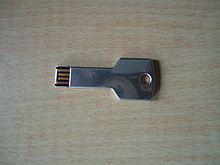
A USB flash drive in the shape of a key

Assortment of USB flash drives
Most USB flash drives weigh less than 30 thou (i oz).[36] While some manufacturers are competing for the smallest size,[37] with the biggest memory, offer drives only a few millimeters larger than the USB plug itself,[38] some manufacturers differentiate their products by using elaborate housings, which are often bulky and brand the drive difficult to connect to the USB port. Because the USB port connectors on a calculator housing are often closely spaced, plugging a wink drive into a USB port may block an next port. Such devices may acquit the USB logo simply if sold with a dissever extension cable. Such cables are USB-compatible but do not adjust to the USB standard.[39] [xl]
USB wink drives have been integrated into other commonly carried items, such equally watches, pens, light amplification by stimulated emission of radiation pointers, and fifty-fifty the Swiss Army Knife; others accept been fitted with novelty cases such as toy cars or Lego bricks. USB flash drives with images of dragons, cats or aliens are very pop in Asia.[41] The minor size, robustness and cheapness of USB flash drives make them an increasingly popular peripheral for case modding.
File organization [edit]
Near flash drives ship preformatted with the FAT32, or exFAT file systems. The ubiquity of the FAT32 file system allows the bulldoze to be accessed on about any host device with USB support. Too, standard FAT maintenance utilities (eastward.g., ScanDisk) can exist used to repair or think corrupted data. All the same, considering a flash drive appears as a USB-continued hard bulldoze to the host organization, the drive can exist reformatted to any file organization supported past the host operating organisation.
Defragmenting [edit]
Flash drives can be defragmented. There is a widespread opinion that defragmenting brings fiddling advantage (as there is no mechanical head that moves from fragment to fragment), and that defragmenting shortens the life of the drive past making many unnecessary writes.[42] However, some sources claim[43] that defragmenting a wink drive can improve operation (mostly due to improved caching of the amassed data), and the boosted wear on flash drives may non be pregnant.
Even distribution [edit]
Some file systems are designed to distribute usage over an entire memory device without concentrating usage on any part (e.thou., for a directory) to prolong the life of elementary wink memory devices. Some USB flash drives have this 'article of clothing leveling' characteristic built into the software controller to prolong device life, while others exercise not, and then it is not necessarily helpful to install one of these file systems.[44]
Hard disk [edit]
Sectors are 512 bytes long, for compatibility with hd drives, and the first sector tin contain a main kick tape and a partition table. Therefore, USB flash units tin be partitioned just like hard disk drives.
Longevity [edit]
The retentiveness in flash drives was unremarkably engineered with multi-level cell (MLC) based retentiveness that is good for around 3,000-5,000 program-erase cycles.[45] Nowadays Triple-level Prison cell (TLC) is too often used, which has up to 500 write cycles per physical sector, while some high-cease flash drives have single-level jail cell (SLC) based memory that is good for effectually thirty,000 writes.[46] There is almost no limit to the number of reads from such wink memory, then a well-worn USB drive may exist write-protected to help ensure the life of individual cells.
Interpretation of flash memory endurance is a challenging subject that depends on the SLC/MLC/TLC memory type, size of the flash retention chips, and actual usage blueprint. Every bit a consequence, a USB flash drive tin can final from a few days to several hundred years.[47]
Regardless of the endurance of the memory itself, the USB connector hardware is specified to withstand only around 1,500 insert-removal cycles.[48]
Apocryphal products [edit]
Counterfeit USB flash drives are sometimes sold with claims of having college capacities than they actually accept. These are typically depression capacity USB drives whose flash retentivity controller firmware is modified so that they emulate larger capacity drives (for example, a two GB bulldoze being marketed as a 64 GB bulldoze). When plugged into a reckoner, they report themselves equally being the larger capacity they were sold every bit, but when information is written to them, either the write fails, the bulldoze freezes up, or it overwrites existing data. Software tools exist to check and detect simulated USB drives,[49] [50] and in some cases it is possible to repair these devices to remove the false capacity information and utilise its real storage limit.[51]
File transfer speeds [edit]
Transfer speeds are technically determined by the slowest of three factors: the USB version used, the speed in which the USB controller device tin read and write data onto the flash memory, and the speed of the hardware jitney, especially in the case of improver USB ports.
USB flash drives usually specify their read and write speeds in megabytes per second (MB/s); read speed is unremarkably faster. These speeds are for optimal atmospheric condition; existent-world speeds are normally slower. In particular, circumstances that often lead to speeds much lower than advertised are transfer (especially writing) of many small files rather than a few very large ones, and mixed reading and writing to the same device.
In a typical well-conducted review of a number of high-functioning USB 3.0 drives, a drive that could read big files at 68 MB/s and write at 46 MB/due south, could only manage xiv MB/south and 0.3 MB/s with many small files. When combining streaming reads and writes the speed of another drive, that could read at 92 MB/s and write at 70 MB/s, was 8 MB/south. These differences differ radically from ane drive to another; some drives could write modest files at over x% of the speed for large ones. The examples given are chosen to illustrate extremes.[52]
Uses [edit]
Personal information transport [edit]
The most mutual utilise of flash drives is to transport and store personal files, such as documents, pictures and videos. Individuals also store medical information on flash drives for emergencies and disaster preparation.
Secure storage of data, awarding and software files [edit]
With wide deployment(s) of wink drives being used in various environments (secured or otherwise), the issue of data and information security remains important. The use of biometrics and encryption is becoming the norm with the demand for increased security for information; on-the-fly encryption systems are specially useful in this regard, as they can transparently encrypt large amounts of data. In some cases a secure USB drive may use a hardware-based encryption mechanism that uses a hardware module instead of software for strongly encrypting information. IEEE 1667 is an attempt to create a generic authentication platform for USB drives. Information technology is supported in Windows 7 and Windows Vista (Service Pack 2 with a hotfix).[53]
Figurer forensics and law enforcement [edit]
A contempo development for the use of a USB Flash Bulldoze every bit an application carrier is to carry the Reckoner Online Forensic Show Extractor (COFEE) awarding developed past Microsoft. COFEE is a gear up of applications designed to search for and excerpt digital bear witness on computers confiscated from suspects.[54] Forensic software is required not to alter, in any way, the information stored on the computer being examined. Other forensic suites run from CD-ROM or DVD-ROM, just cannot store data on the media they are run from (although they can write to other attached devices, such as external drives or memory sticks).
Updating motherboard firmware [edit]
Motherboard firmware (including BIOS and UEFI) can be updated using USB flash drives. Usually, new firmware prototype is downloaded and placed onto a FAT16- or FAT32-formatted USB wink drive connected to a system which is to exist updated, and path to the new firmware image is selected within the update component of system's firmware.[55] Some motherboard manufacturers are as well allowing such updates to be performed without the need for inbound system'southward firmware update component, making it possible to easily recover systems with corrupted firmware.[56]
Also, HP has introduced a USB floppy drive central, which is an ordinary USB flash drive with additional possibility for performing floppy bulldoze emulation, assuasive its usage for updating system firmware where straight usage of USB wink drives is non supported. Desired manner of performance (either regular USB mass storage device or of floppy bulldoze emulation) is made selectable past a sliding switch on the device'due south housing.[57] [58]
Booting operating systems [edit]
Nigh electric current PC firmware permits booting from a USB drive, allowing the launch of an operating organization from a bootable flash drive. Such a configuration is known as a Live USB.[59]
Original flash retentiveness designs had very limited estimated lifetimes. The failure mechanism for flash memory cells is analogous to a metal fatigue style; the device fails by refusing to write new data to specific cells that accept been subject area to many read-write cycles over the device's lifetime. Premature failure of a "live USB" could be circumvented by using a flash bulldoze with a write-lock switch as a WORM device, identical to a alive CD. Originally, this potential failure mode limited the utilise of "alive USB" system to special-purpose applications or temporary tasks, such as:
- Loading a minimal, hardened kernel for embedded applications (e.1000., network router, firewall).
- Bootstrapping an operating system install or deejay cloning functioning, frequently across a network.
- Maintenance tasks, such every bit virus scanning or low-level information repair, without the primary host operating arrangement loaded.
As of 2011[update], newer wink retentivity designs have much higher estimated lifetimes. Several manufacturers are at present offering warranties of five years or more. Such warranties should brand the device more attractive for more than applications. By reducing the probability of the device's premature failure, flash memory devices can now be considered for use where a magnetic disk would normally have been required. Flash drives have also experienced an exponential growth in their storage capacity over time (following the Moore's Police force growth curve). As of 2013, single-packaged devices with capacities of i TB are readily available,[60] and devices with 16 GB chapters are very economical. Storage capacities in this range take traditionally been considered to offer adequate infinite, considering they let enough space for both the operating system software and some free infinite for the user's data.
Operating system installation media [edit]
Installers of some operating systems can exist stored to a flash drive instead of a CD or DVD, including various Linux distributions, Windows 7 and newer versions, and macOS. In item, Mac OS 10 ten.vii is distributed but online, through the Mac App Store, or on wink drives; for a MacBook Air with Boot Military camp and no external optical drive, a flash drive tin exist used to run installation of Windows or Linux.
However, for installation of Windows 7 and later versions, using USB flash drive with hard disk drive emulation equally detected in PC's firmware is recommended in gild to kicking from it. Transcend is the only manufacturer of USB flash drives containing such feature.
Furthermore, for installation of Windows XP, using USB flash bulldoze with storage limit of at nearly 2 GB is recommended in social club to kicking from information technology.
Windows ReadyBoost [edit]
In Windows Vista and afterward versions, ReadyBoost characteristic allows wink drives (from iv GB in example of Windows Vista) to augment operating system memory.[61]
Application carriers [edit]
Wink drives are used to carry applications that run on the host computer without requiring installation. While any standalone application can in principle be used this style, many programs store data, configuration information, etc. on the hard drive and registry of the host figurer.
The U3 company works with drive makers (parent visitor SanDisk too as others) to evangelize custom versions of applications designed for Microsoft Windows from a special wink drive; U3-compatible devices are designed to autoload a menu when plugged into a figurer running Windows. Applications must be modified for the U3 platform non to leave any data on the host auto. U3 as well provides a software framework for independent software vendors interested in their platform.
Ceedo is an alternative product, with the cardinal difference that it does non require Windows applications to be modified in order for them to exist carried and run on the drive.
Similarly, other application virtualization solutions and portable application creators, such every bit VMware ThinApp (for Windows) or RUNZ (for Linux) tin can exist used to run software from a flash bulldoze without installation.
In October 2010, Apple Inc. released their newest iteration of the MacBook Air, which had the system'southward restore files independent on a USB difficult bulldoze rather than the traditional install CDs, due to the Air not coming with an optical drive.[62]
A wide range of portable applications which are all gratuitous of accuse, and able to run off a estimator running Windows without storing anything on the host estimator'due south drives or registry, can be found in the listing of portable software.
Backup [edit]
Some value-added resellers are now using a wink drive every bit role of minor-business organization turnkey solutions (e.one thousand., indicate-of-auction systems). The drive is used as a backup medium: at the shut of business concern each night, the drive is inserted, and a database backup is saved to the drive. Alternatively, the drive can be left inserted through the business organization mean solar day, and data regularly updated. In either case, the drive is removed at dark and taken offsite.
- This is simple for the cease-user, and more probable to exist done.
- The drive is pocket-sized and convenient, and more likely to exist carried off-site for safe.
- The drives are less fragile mechanically and magnetically than tapes.
- The capacity is ofttimes large enough for several backup images of disquisitional data.
- Wink drives are cheaper than many other backup systems.
Flash drives also have disadvantages. They are easy to lose and facilitate unauthorized backups. A lesser setback for wink drives is that they have only 1 tenth the capacity of hard drives manufactured around their time of distribution.
Password Reset Deejay [edit]
Countersign Reset Disk is a feature of the Windows operating system. If a user sets up a Password Reset Disk, it can be used to reset the password on the computer it was ready on.
Audio players [edit]

A contemporary pollex drive styled solid-land digital audio player (Sony Walkman B180 Serial)
Many companies brand small solid-state digital audio players, essentially producing flash drives with audio output and a unproblematic user interface. Examples include the Creative MuVo, Philips GoGear and the kickoff generation iPod shuffle. Some of these players are true USB flash drives every bit well as music players; others do non support general-purpose data storage. Other applications requiring storage, such as digital vocalisation or sound recording, can also be combined with flash drive functionality.[63]
Many of the smallest players are powered by a permanently fitted rechargeable battery, charged from the USB interface. Fancier devices that office equally a digital audio actor have a USB host port (type A female typically).
Media storage and marketing [edit]

The German band Wizo'due south Stick EP, released in 2004, was the first album released on a USB stick.
Digital sound files tin can be transported from i reckoner to another similar whatsoever other file, and played on a compatible media player (with caveats for DRM-locked files). In addition, many dwelling house Hi-Fi and car stereo caput units are at present equipped with a USB port. This allows a USB flash bulldoze containing media files in a variety of formats to exist played directly on devices which support the format. Some LCD monitors for consumer HDTV viewing have a defended USB port through which music and video files can also exist played without use of a personal reckoner.
Artists have sold or given away USB wink drives, with the commencement instance believed to be in 2004 when the German punk band Wizo released the Stick EP, simply as a USB drive. In improver to five high-bitrate MP3s, information technology also included a video, pictures, lyrics, and guitar tablature.[64] Subsequently, artists including Nine Inch Nails and Kylie Minogue[65] have released music and promotional cloth on USB flash drives. The start USB album to be released in the UK was Kiss Does... Rave, a compilation album released by the Osculation Network in April 2007.[66]
Brand and production promotion [edit]

The availability of inexpensive flash drives has enabled them to be used for promotional and marketing purposes, peculiarly within technical and reckoner-industry circles (east.g., technology trade shows). They may be given away for free, sold at less than wholesale toll, or included as a bonus with another purchased product.
Commonly, such drives will be custom-stamped with a company'southward logo, as a form of advertizing. The drive may be blank, or preloaded with graphics, documentation, web links, Flash animation or other multimedia, and costless or demonstration software. Some preloaded drives are read-merely, while others are configured with both read-only and user-writable segments. Such dual-division drives are more than expensive.[67]
Flash drives can be set up to automatically launch stored presentations, websites, manufactures, and whatever other software immediately on insertion of the drive using the Microsoft Windows AutoRun feature.[68] Autorunning software this way does not work on all computers, and it is normally disabled by security-witting users.
Arcades [edit]
In the arcade game In the Groove and more commonly In The Groove two, flash drives are used to transfer high scores, screenshots, trip the light fantastic toe edits, and combos throughout sessions. As of software revision 21 (R21), players tin also shop custom songs and play them on whatsoever machine on which this feature is enabled. While use of flash drives is mutual, the drive must be Linux compatible.[ citation needed ]
In the arcade games Pump it Up NX2 and Pump it Up NXA, a specially produced flash drive is used as a "relieve file" for unlocked songs, besides every bit for progressing in the WorldMax and Encephalon Shower sections of the game.[ citation needed ]
In the arcade game Dance Dance Revolution 10, an exclusive USB flash bulldoze was made by Konami for the purpose of the link feature from its Sony PlayStation ii counterpart. However, any USB flash drive tin be used in this arcade game.[ commendation needed ]
Conveniences [edit]
Flash drives use little power, have no delicate moving parts, and for most capacities are small and light. Data stored on wink drives is impervious to mechanical daze, magnetic fields, scratches and dust. These properties make them suitable for transporting data from place to identify and keeping the data readily at hand.
Wink drives also store data densely compared to many removable media. In mid-2009, 256 GB drives became available, with the ability to hold many times more data than a DVD (54 DVDs) or even a Blu-ray (x BDs).[69]
Flash drives implement the USB mass storage device course so that almost modernistic operating systems can read and write to them without installing device drivers. The wink drives present a simple block-structured logical unit to the host operating system, hiding the private circuitous implementation details of the various underlying flash retentivity devices. The operating system can utilise whatever file arrangement or cake addressing scheme. Some computers can boot up from flash drives.
Specially manufactured flash drives are available that take a tough rubber or metal casing designed to be waterproof and virtually "unbreakable". These flash drives retain their retention after being submerged in water, and even through a machine launder. Leaving such a flash drive out to dry completely earlier allowing current to run through it has been known to event in a working drive with no futurity problems. Channel Five's Gadget Show cooked ane of these flash drives with propane, froze information technology with dry water ice, submerged it in various acidic liquids, ran over information technology with a jeep and fired information technology against a wall with a mortar. A visitor specializing in recovering lost information from computer drives managed to recover all the data on the drive.[70] All data on the other removable storage devices tested, using optical or magnetic technologies, were destroyed.
Comparing with other portable storage [edit]

Punched cards in storage at a U.S. Federal records heart in 1959. All the data visible here could fit on a single wink drive.
Tape [edit]
The applications of current data record cartridges inappreciably overlap those of wink drives: on record, price per gigabyte is very low for large volumes, but the individual drives and media are expensive. Media have a very high chapters and very fast transfer speeds, but shop data sequentially and are very tedious for random access of data. While disk-based backup is now the principal medium of pick for near companies, tape backup is still popular for taking data off-site for worst-case scenarios and for very large volumes (more than a few hundreds of TB). Run across LTO tapes.
Floppy deejay [edit]

Size comparing of a wink drive and a 3.5-inch floppy disk. The flash drive tin can hold about 11,380 times more information.
Floppy disk drives are rarely fitted to modernistic computers and are obsolete for normal purposes, although internal and external drives tin can be fitted if required. Floppy disks may be the method of option for transferring information to and from very old computers without USB or booting from floppy disks, and then they are sometimes used to change the firmware on, for case, BIOS chips. Devices with removable storage like older Yamaha music keyboards are also dependent on floppy disks, which require computers to procedure them. Newer devices are built with USB flash bulldoze support.
Floppy deejay hardware emulators be which finer utilize the internal connections and physical attributes of a floppy disk bulldoze to utilize a device where a USB wink drive emulates the storage space of a floppy disk in a solid country form, and tin exist divided into a number of individual virtual floppy disk images using individual data channels.
Optical media [edit]
The various writable and re-writable forms of CD and DVD are portable storage media supported past the vast majority of computers as of 2008. CD-R, DVD-R, and DVD+R can be written to only once, RW varieties up to almost 1,000 erase/write cycles, while modern NAND-based wink drives often last for 500,000 or more erase/write cycles. DVD-RAM discs are the most suitable optical discs for data storage involving much rewriting.
Optical storage devices are among the cheapest methods of mass data storage after the hard drive. They are slower than their flash-based counterparts. Standard 120 mm optical discs are larger than wink drives and more field of study to damage. Smaller optical media do exist, such equally business card CD-Rs which have the same dimensions as a credit menu, and the slightly less convenient but higher capacity eighty mm recordable MiniCD and Mini DVD. The small discs are more expensive than the standard size, and practice non piece of work in all drives.
Universal Disk Format (UDF) version 1.50 and higher up has facilities to back up rewritable discs like sparing tables and virtual allocation tables, spreading usage over the entire surface of a disc and maximising life, just many older operating systems do non support this format. Packet-writing utilities such as DirectCD and InCD are available only produce discs that are not universally readable (although based on the UDF standard). The Mountain Rainier standard addresses this shortcoming in CD-RW media by running the older file systems on peak of it and performing defect management for those standards, merely information technology requires back up from both the CD/DVD burner and the operating arrangement. Many drives fabricated today do not support Mount Rainier, and many older operating systems such as Windows XP and below, and Linux kernels older than 2.6.2, do non back up it (later versions do). Essentially CDs/DVDs are a skillful style to record a great deal of information cheaply and take the reward of being readable by near standalone players, just they are poor at making ongoing small-scale changes to a large collection of data. Flash drives' ability to do this is their major advantage over optical media.
Flash memory cards [edit]

Three different Micro Centre-branded digital media, showing a USB flash bulldoze, an SD card, and a Micro-SD card, all having a capacity of 8 GiB, adjacent to a U.S five-cent money for size comparing
Wink retentiveness cards, due east.g., Secure Digital cards, are bachelor in various formats and capacities, and are used by many consumer devices. However, while almost all PCs accept USB ports, allowing the use of USB flash drives, memory menu readers are non normally supplied as standard equipment (particularly with desktop computers). Although cheap card readers are available that read many mutual formats, this results in ii pieces of portable equipment (carte plus reader) rather than 1.
Some manufacturers, aiming at a "best of both worlds" solution, have produced card readers that arroyo the size and form of USB flash drives (eastward.g., Kingston MobileLite,[71] SanDisk MobileMate[72]) These readers are limited to a specific subset of memory card formats (such as SD, microSD, or Memory Stick), and oftentimes completely enclose the card, offering durability and portability approaching, if not quite equal to, that of a flash drive. Although the combined cost of a mini-reader and a memory card is unremarkably slightly higher than a USB flash drive of comparable capacity, the reader + carte solution offers additional flexibility of apply, and nearly "unlimited" chapters. The ubiquity of SD cards is such that, circa 2011, due to economies of scale, their price is at present less than an equivalent-chapters USB flash drive, even with the added cost of a USB SD card reader.
An additional advantage of retention cards is that many consumer devices (e.one thousand., digital cameras, portable music players) cannot make utilise of USB flash drives (even if the device has a USB port), whereas the memory cards used by the devices tin can exist read by PCs with a carte du jour reader.
External hard disk [edit]
Particularly with the appearance of USB, external hard disks take get widely available and cheap. External hd drives currently cost less per gigabyte than flash drives and are available in larger capacities. Some hard drives support alternative and faster interfaces than USB 2.0 (e.chiliad., Thunderbolt, FireWire and eSATA). For consecutive sector writes and reads (for instance, from an unfragmented file), well-nigh difficult drives can provide a much higher sustained data charge per unit than electric current NAND wink memory, though mechanical latencies seriously impact hard drive operation.
Different solid-state memory, difficult drives are susceptible to impairment past stupor (eastward.g., a brusk autumn) and vibration, have limitations on use at loftier distance, and although they are shielded by their casings, they are vulnerable when exposed to strong magnetic fields. In terms of overall mass, hard drives are usually larger and heavier than wink drives; however, hard disks sometimes weigh less per unit of measurement of storage. Like wink drives, hard disks also suffer from file fragmentation, which can reduce access speed[ commendation needed ].
Obsolete devices [edit]
Audio record cassettes and high-capacity floppy disks (e.g., Imation SuperDisk), and other forms of drives with removable magnetic media, such as the Iomega Null bulldoze and Jaz drives, are now largely obsolete and rarely used. There are products in today'southward market place that will emulate these legacy drives for both tape and deejay (SCSI1/SCSI2, SASI, Magneto optic, Ricoh Cypher, Jaz, IBM3590/ Fujitsu 3490E and Bernoulli for instance) in land-of-the-fine art Meaty Flash storage devices – CF2SCSI.
Encryption and security [edit]
Equally highly portable media, USB flash drives are easily lost or stolen. All USB flash drives can take their contents encrypted using third-party disk encryption software, which can frequently be run straight from the USB drive without installation (for instance, FreeOTFE), although some, such as BitLocker, require the user to accept administrative rights on every computer information technology is run on.
Archiving software tin can achieve a similar event by creating encrypted Cypher or RAR files.[73] [74]
Some manufacturers have produced USB flash drives which use hardware-based encryption every bit part of the design,[75] removing the demand for 3rd-party encryption software. In limited circumstances these drives have been shown to have security bug, and are typically more expensive than software-based systems, which are available for free.
A minority of flash drives support biometric fingerprinting to confirm the user's identity. As of mid-2005[update],[ needs update ] this was an expensive alternative to standard countersign protection offered on many new USB flash storage devices. Most fingerprint scanning drives rely upon the host operating system to validate the fingerprint via a software commuter, often restricting the drive to Microsoft Windows computers. However, there are USB drives with fingerprint scanners which use controllers that allow access to protected data without any authentication.[76]
Some manufacturers deploy physical authentication tokens in the class of a flash drive. These are used to command admission to a sensitive system past containing encryption keys or, more ordinarily, communicating with security software on the target auto. The system is designed then the target machine volition not operate except when the wink bulldoze device is plugged into it. Some of these "PC lock" devices also function as normal wink drives when plugged into other machines.
Controversies [edit]
Criticisms [edit]
Failures [edit]
Like all flash memory devices, flash drives tin can sustain only a limited number of write and erase cycles before the drive fails.[77] [ unreliable source? ] [78] This should be a consideration when using a flash bulldoze to run awarding software or an operating system. To address this, as well as infinite limitations, some developers have produced special versions of operating systems (such as Linux in Live USB)[79] or commonplace applications (such as Mozilla Firefox) designed to run from flash drives. These are typically optimized for size and configured to identify temporary or intermediate files in the computer's main RAM rather than store them temporarily on the flash drive.
When used in the same manner every bit external rotating drives (hard drives, optical drives, or floppy drives), i.e. in ignorance of their engineering, USB drives' failure is more than likely to exist sudden: while rotating drives tin can fail instantaneously, they more frequently requite some indication (noises, slowness) that they are about to neglect, ofttimes with enough advance warning that data can exist removed earlier total failure. USB drives give little or no advance warning of failure. Furthermore, when internal wearable-leveling is applied to prolong life of the wink drive, once failure of even part of the retentivity occurs it can be difficult or impossible to use the remainder of the drive, which differs from magnetic media, where bad sectors tin can exist marked permanently not to be used.[80]
Most USB wink drives do not include a write protection mechanism. This characteristic, which gradually became less common, consists of a switch on the housing of the drive itself, that prevents the host computer from writing or modifying information on the drive. For case, write protection makes a device suitable for repairing virus-contaminated host computers without the risk of infecting a USB wink bulldoze itself. In dissimilarity to SD cards, write protection on USB flash drives (when available) is connected to the drive circuitry, and is handled by the bulldoze itself instead of the host (on SD cards handling of the write-protection notch is optional).
A drawback to the modest physical size of flash drives is that they are easily misplaced or otherwise lost. This is a particular problem if they contain sensitive data (run into data security). As a outcome, some manufacturers have added encryption hardware to their drives, although software encryption systems which can be used in conjunction with any mass storage medium will achieve the same result. Nigh drives can be fastened to keychains or lanyards. The USB plug is usually retractable or fitted with a removable protective cap.
Robustness [edit]
Most USB-based flash technology integrates a printed circuit board with a metal tip, which is simply soldered on. Equally a result, the stress point is where the ii pieces join. The quality control of some manufacturers does not ensure a proper solder temperature, further weakening the stress bespeak.[81] [82] Since many wink drives stick out from computers, they are likely to be bumped repeatedly and may intermission at the stress point. About of the time, a break at the stress bespeak tears the articulation from the printed circuit lath and results in permanent damage. However, some manufacturers produce discreet wink drives that do non stick out, and others utilize a solid metal or plastic uni-torso that has no easily discernible stress point. SD cards serve as a adept alternative to USB drives since they can exist inserted affluent.
Security threats [edit]
USB killer [edit]
In appearance similar to a USB flash drive, a USB killer is a excursion that charges up capacitors to a high voltage using the power supply pins of a USB port then discharges high voltage pulses onto the data pins. This completely standalone device tin can instantly and permanently damage or destroy any host hardware that it is connected to.[83]
"Flash Drives for Liberty" [edit]
The New York-based Human Rights Foundation collaborated with Forum 280 and USB Memory Directly to launch the "Wink Drives for Liberty" program.[84] [85] The program was created in 2016 to smuggle flash drives with American and South Korean movies and television shows, as well equally a copy of the Korean Wikipedia, into Northward Korea to spread pro-Western sentiment.[86] [87]
Current and future developments [edit]

The internals of a 32 GB Toshiba USB 3.0 flash drive. The USB 3.0 standard is becoming increasingly pop. This drive has a write speed of 60 MB/s and a read speed of 120 MB/south, making it faster than the USB 2.0 standard.
Semiconductor corporations have worked to reduce the cost of the components in a wink drive by integrating various wink drive functions in a single fleck, thereby reducing the office-count and overall parcel-cost.
Flash drive capacities on the market increase continually. High speed has become a standard for modern flash drives. Capacities exceeding 256 GB were available on the market as early every bit 2009.[69]
Lexar is attempting to introduce a USB FlashCard, which would be a compact USB wink drive intended to replace diverse kinds of flash memory cards. Pretec introduced a similar card, which also plugs into any USB port, but is only 1 quarter the thickness of the Lexar model.[88] Until 2008, SanDisk manufactured a product called SD Plus, which was a SecureDigital menu with a USB connector.[89]
SanDisk has besides introduced a new technology to permit controlled storage and usage of copyrighted materials on wink drives, primarily for use by students. This technology is termed FlashCP.
See also [edit]
- List of reckoner hardware
- Memristor
- Microdrive
- Nonvolatile BIOS retentivity
- Portable awarding
- ReadyBoost
- Sneakernet
- Solid-state drive (SSD)
- USB dead drop
- USB Flash Bulldoze Alliance
- Windows To Go
- Deejay enclosure
- External storage
Notes [edit]
- ^ Jumpdrive is a Lexar trademark.[two] Less common names are disk key, disk on key (later on the original M-Systems DiskOnKey drive from 2000),[iii] flash stick, gig stick, memory stick (non to exist confused with the Sony Memory Stick), pen bulldoze, USB drive, USB primal, USB memory, or USB stick. For an incomplete listing of alternative names, see the list of redirects to this article.
References [edit]
- ^ "thumb drive". Merriam-Webster . Retrieved December xi, 2021.
- ^ "Jumpdrive". Merriam-Webster . Retrieved December eleven, 2021.
- ^ a b c "Object of Interest: The Flash Drive". The New Yorker . Retrieved 2018-10-04 .
- ^ 1 GB = ane billion bytes
- ^ ane TB = one thousand gigabytes
- ^ a b Madison, Alex (2016-07-09). "Keychain Not Included: The Five Highest-Chapters USB Wink Drives for Your Digital Life". Digital Trends . Retrieved 17 October 2016.
- ^ a b Athow, Want (2016-07-04). "The best USB flash drives 2016". Tech Radar . Retrieved 17 Oct 2016.
- ^ "The Largest Flash Drives | Digital Trends". Digital Trends. 2018-07-23. Retrieved 2018-10-09 .
- ^ USB wink drives allow reading, writing, and erasing of data, with some allowing ane 1000000 write/erase cycles in each cell of memory: if there were 100 uses per 24-hour interval, 1 million cycles could bridge x,000 days or over 27 years. Some devices level the usage by machine-shifting activeness to underused sections of memory.
- ^ "USB Flash drive Resurrection". SecTechno. 29 May 2011. Retrieved 12 December 2021.
- ^ "Understanding Life Expectancy of Wink Storage". world wide web.ni.com. 2020-07-23. Retrieved 2020-12-19 .
- ^ "Flash Memory". TU Wien . Retrieved four December 2019.
- ^ Harris, David; Harris, Sarah (2010). Digital Design and Computer Architecture. Morgan Kaufmann. pp. 263–four. ISBN978-0-08-054706-0.
- ^ [1], "Architecture for a universal serial double-decker-based PC flash disk", issued 1999-04-05
- ^ "Who invented the Thumb-Drive?". Kodak Digitizing . Retrieved 2021-03-25 .
- ^ "History Of The Flash Drive". MediaFast. 2015-04-23. Retrieved 2021-03-25 .
- ^ "Who Invented the USB Flash Drive? - Premium USB". www.premiumusb.com . Retrieved 2021-03-25 .
- ^ "'Father of pen bulldoze' now a Datuk | The Star". www.thestar.com.my . Retrieved 2021-03-25 .
- ^ "Patent Expires for Flash Memory Sticks, Invented by a Chinese Company-Jiemian Global". en.jiemian.com . Retrieved 2021-03-25 .
- ^ "Singapore business firm wins patent on thumb drive". The Straits Times . Retrieved 2006-08-01 .
- ^ "Trek 2000 and the ThumbDrive". nlb.gov.sg. March 23, 2010. Retrieved 2016-06-25 .
- ^ "iv Optical Drives through Port Multiplier". vampiric.us. Archived from the original on 28 December 2014. Retrieved 22 Dec 2014.
- ^ "USB 1.0 vs. USB ii.0". Diffen. Retrieved 22 Dec 2014.
- ^ "Reducing Seek Overhead with Application-Directed Prefetching". Usenix.org. Usenix. Retrieved 22 December 2014.
- ^ Edwards, Nathan. "Why Storage Drive Speeds Don't Striking Their Theoretical Limits". Tested. Retrieved 22 December 2014.
- ^ a b "Want a laptop with USB 3.0? The few, the proud". CNET. 2010-09-19. Retrieved 2018-10-ten .
- ^ "All-Time 100 Gadgets". Time. 2010-10-25. Archived from the original on Oct 28, 2010.
- ^ "Kingston unveils 1 terabyte flash drive". United states Today . Retrieved 2018-10-x .
- ^ "PK: the World's Starting time USB Kit with 3.1 technology". Retrieved 1 June 2016.
- ^ Mullen, Jethro. "The world'southward biggest flash drive can store more than 160 HD movies". CNNMoney . Retrieved 2018-ten-x .
- ^ "SanDisk shows off the world'due south smallest 1TB USB-C wink bulldoze at CES". TheVerge.com. 9 January 2018.
- ^ Broida, Rick (2013-12-10). "PKparis unveils world's smallest Android flash drive | Android Atlas - CNET Reviews". Reviews.cnet.com. Retrieved 2014-02-19 .
- ^ "What's Inside a USB Drive?". PremiumUSB.com . Retrieved 2018-10-10 .
- ^ PNY USB Wink Drive – CES 2006 – LetsGoDigital. Ces-show.com. Retrieved on 2011-05-18.
- ^ BlueTrek Bizz – an expandable USB and a Bluetooth headset in one Archived 2014-08-29 at the Wayback Machine. TechChee.com (2008-05-20). Retrieved on 2011-05-xviii.
- ^ Frequently Asked Questions Virtually USB Flash Drives. Retrieved on 2011-05-18.
- ^ Newman, Jared (2015-06-17). "World'southward smallest 128GB USB 3.0 drive: PKParis K'1 picks a fight with SanDisk Ultra Fit". PCWorld . Retrieved 2017-06-06 .
- ^ Marino, Robert (2015-09-x). "Guide: The twenty Best Small USB Flash Drives". Computershopper.com . Retrieved 2017-06-06 .
- ^ "Archived copy" (PDF). Archived from the original (PDF) on 2016-03-04. Retrieved 2016-06-01 .
{{cite web}}: CS1 maint: archived copy as title (link) - ^ "USB 2.0 Specification Engineering Modify Discover (ECN) #1: Mini-B connector" (PDF). Archived from the original (PDF) on 2015-04-12. Retrieved one June 2016.
- ^ Bizarre USB wink drives from the Far East Archived 2012-03-20 at the Wayback Machine (German), t3n (2012-03-07). Retrieved on 2012-03-17.
- ^ Should I defragment my USB Wink drive?. Ask-leo.com (2008-02-nineteen). Retrieved on 2011-05-18.
- ^ "Flash Retention Fragmentation – Myths and Facts". Wizcode.com. Archived from the original on 2017-06-fourteen. Retrieved 2017-06-06 .
- ^ "TN-29-42: Wear-Leveling Techniques in NAND Flash Devices" (PDF). Archived from the original (PDF) on 22 March 2012. Retrieved one June 2016.
- ^ "Kingston HyperX 3K (240GB) SSD Review". Anandtec.com. 2012-04-10. Retrieved 2012-x-05 .
- ^ "Kingston'southward Flash Memory Guide - Kingston Applied science".
- ^ "How Long Does a USB Wink Drive Terminal? (Role Two)". Promotional USB Flash Drives and Accessories.
- ^ Blanchard, Richard (March eighth, 2007) "What is the Life Cycle of a USB Flash Drive?", GetUSB.info, retrieved June 14, 2010
- ^ "H2testw USB flash bulldoze examination tool", world wide web.heise.de, retrieved November 16, 2010
- ^ "Определение модели контроллера и памяти флешки" [Detecting controller model and memory type of flash drive] (in Russian). usbdev.ru. 20 February 2013. Retrieved 2018-01-06 .
- ^ "About VID PID Repairing Counterfeit Flash Drives – Steps To Succeed", fixfakeflash.wordpress.com, retrieved November 16, 2010
- ^ Tom's Hardware: Nine USB 3.0 Flash Drives For Road Warriors, 26 April 2011
- ^ "An update is bachelor that enables the support of Enhanced Storage devices in Windows Vista and in Windows Server 2008". Microsoft Back up. Nov 23, 2010.
- ^ Romano, Benjamin J. (2008-04-29). "Microsoft device helps police pluck testify from cyberscene of crime". The Seattle Times . Retrieved 2008-04-29 .
- ^ "ASUS EZ Wink ii utility". northernmicro.com. 2013-12-21. Archived from the original on 2012-09-17. Retrieved 2014-01-16 .
- ^ "How to Utilise USB BIOS Flashback". ASUS. 2012. Retrieved 2014-01-16 .
- ^ "HP USB Floppy Drive Cardinal Support - HP Support Centre". Archived from the original on 14 Jan 2014.
- ^ "HP USB Floppy Bulldoze Key". SlashGear. 24 October 2008. Retrieved 2017-06-06 .
- ^ Kicking Windows from a certified USB flash drive. Retrieved on fourteen May 2014
- ^ Jane McEntegart (2013-01-08). "Hands-on with Kingston's 1TB USB Stick". Tomshardware.com. Retrieved 2014-03-08 .
- ^ Brinkmann, Martin (2008-xi-01). "Windows seven to Extend Readyboost". Windows 7 News. Archived from the original on 2009-01-06. Retrieved 2009-05-12 .
- ^ "Yep, Apple Killed The CD Today". TechCrunch.com. October 20, 2010.
- ^ From the manual for a typical digital vocalism recorder: "Apart from using this unit as a recorder, y'all can use it as an external memory for your reckoner, as an external storage device."
- ^ Patalong, Frank (2004-x-06). "Vorbespielter USB-Stick: Musik zum Löschen". Spiegel Online (in German). Der Spiegel. Retrieved 2014-06-26 .
- ^ X (USB): Kylie Minogue: Amazon.co.uk: Music. Amazon.co.uk. Retrieved on 2011-05-18.
- ^ "Albums arrive on USB format". Music Calendar week. 23 April 2007. ISSN 0265-1548. OCLC 60620772. Archived from the original on 8 September 2013. Retrieved viii September 2013.
- ^ "Archived copy". Archived from the original on 2015-04-23. Retrieved 2016-02-09 .
{{cite web}}: CS1 maint: archived copy as title (link) - ^ USB flash drive machine run setup, article from Flashbay.com
- ^ a b Baker, Jeff (July 20, 2009) "Kingston unveils 256GB pollex" Archived 2012-03-22 at the Wayback Machine, MobileWhack.com
- ^ testing removable media on YouTube on the Gadget Show.
- ^ "MobileLite 9-in-1 Reader". Kingston Technology. Archived from the original on 2009-02-27. Retrieved 2009-04-08 .
- ^ "MobileMate Memory Stick Plus 4-in-ane Reader". Sandisk Corporation. Archived from the original on March 5, 2009. Retrieved 2009-04-08 .
- ^ Arlen Walker. "Technical Specifications - PKZIP Server - PKWARE - server - pkzip - software". pkware.com . Retrieved 29 June 2015.
- ^ "WinRAR archiver, a powerful tool to process RAR and ZIP files". rarlab.com . Retrieved 29 June 2015.
- ^ "Archived copy". Archived from the original on 2013-01-24. Retrieved 2016-02-09 .
{{cite web}}: CS1 maint: archived re-create equally championship (link) - ^ "heise online - IT-News, Nachrichten und Hintergründe". heise online.
- ^ How Long Does a Flash Drive Last? – Josh's Blog Archived 2010-02-thirteen at the Wayback Machine. 2008-05-23, Bress.net. Retrieved on 2011-05-xviii.
- ^ "What is flash drive wear leveling" (PDF). Archived from the original (PDF) on February 6, 2009.
- ^ Mass Storage Devices. Linux-usb.sourceforge.net. Retrieved on 2011-05-xviii.
- ^ Notenboom, Leo A. (2008-05-06). "How do I fix bad sectors on a flash drive?". Ask-leo.com . Retrieved 2017-06-06 .
- ^ Wikipedia entry "Soldering Defects in Electronics
- ^ Wikipedia entry "Processes – Electronic Components (PCBs)"
- ^ Constantin, Lucian (Mar 13, 2015). "USB Killer is a wink drive designed to fry your laptop". PC Earth . Retrieved May 2, 2018.
- ^ Taggart, Emma (22 Baronial 2018). "You Can Donate Old USB Drives to These Activists to Help Free North Koreans of Propaganda". My Mod Met . Retrieved 10 Jan 2019.
- ^ Desreumaux, Geoff (23 August 2018). "Wink Drives For Freedom: Your Sometime USB Drives Tin Help Overthrow Dictatorships". WeRSM - We are Social Media . Retrieved 10 January 2019.
- ^ Hands, Jack (March 22, 2016). "Flashdrives for freedom? 20,000 USBs to be smuggled into Democratic people's republic of korea". The Guardian . Retrieved March xviii, 2017.
- ^ Bragg, Austin; Bragg, Meredith; Detrick, Paul (March 15, 2017). "#SXSW: How Activists Are Using Technology to Fight Dictators". Reason Foundation . Retrieved March 18, 2017.
- ^ Administrator. "Pretec - Small size, Big touch". Retrieved i June 2016.
- ^ "SanDisk Ultra II SD Plus Cards". SanDisk. Retrieved 2008-03-02 .
Source: https://en.wikipedia.org/wiki/USB_flash_drive
0 Response to "what company was the first to sell a usb flash drive"
Post a Comment