This Fertile Land Signs and Symbols in the Early Arts of Iran and Iraq
| 𒌶𒆠 URI5 KI , 𒋀𒀕𒆠 or 𒋀𒀊𒆠 Urim (Sumerian) | |
 Ziggurat of Ur | |
| Ur Shown within Iraq Show map of Iraq Ur Ur (Virtually Due east) Show map of Nearly Due east Ur Ur (West and Central Asia) Show map of Due west and Central Asia | |
| Location | Tell el-Muqayyar, Dhi Qar Governorate, Iraq |
|---|---|
| Region | Mesopotamia, Eye East |
| Coordinates | 30°57′42″Northward 46°06′18″Eastward / 30.9616529°Northward 46.1051259°Due east / xxx.9616529; 46.1051259 Coordinates: 30°57′42″N 46°06′18″Due east / 30.9616529°N 46.1051259°Eastward / thirty.9616529; 46.1051259 |
| Type | Settlement |
| History | |
| Founded | c. 3800 BC |
| Abandoned | afterward 500 BC |
| Periods | Ubaid period to Iron Age |
| Cultures | Sumerian |
| Site notes | |
| Excavation dates | 1853–1854, 1922–1934 |
| Archaeologists | John George Taylor, Charles Leonard Woolley |
| UNESCO World Heritage Site | |
| Official proper noun | Ur Archaeological City |
| Part of | Ahwar of Southern Iraq |
| Criteria | Mixed: (three)(v)(nine)(ten) |
| Reference | 1481-006 |
| Inscription | 2016 (40th Session) |
| Area | 71 ha (0.27 sq mi) |
| Buffer zone | 317 ha (i.22 sq mi) |
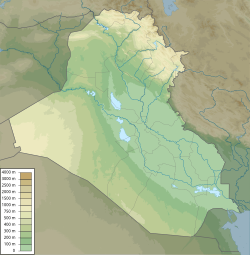


Ur (; Sumerian: Urim;[i] Sumerian Cuneiform: 𒌶𒆠 URI5 KI , 𒋀𒀕𒆠 URIM2 KI or 𒋀𒀊𒆠 URIM5 KI ;[2] Akkadian: 𒋀𒀕𒆠, romanized: Uru ;[3] Arabic: أُوْر, romanized: ʾūr ; Hebrew: אוּר, romanized: ʾūr ) was an of import Sumerian metropolis-country in ancient Mesopotamia, located at the site of modern "Tell el-Muqayyar" (Arabic: تل ٱلْمُقَيَّر) in south Iraq's Dhi Qar Governorate.[iv] Although Ur was in one case a coastal city near the mouth of the Euphrates on the Persian Gulf, the coastline has shifted and the city is now well inland, on the south bank of the Euphrates, sixteen kilometres (9.ix miles) from Nasiriyah in modern-day Iraq.[5] The metropolis dates from the Ubaid flow circa 3800 BC, and is recorded in written history as a city-state from the 26th century BC, its starting time recorded king being Mesannepada.
The urban center'southward patron deity was Nanna (in Akkadian, Sin), the Sumerian and Akkadian moon god, and the proper noun of the city is in origin derived from the god's name, UNUGKI, literally "the abode (UNUG) of Nanna".[5] The site is marked past the partially restored ruins of the Ziggurat of Ur, which contained the shrine of Nanna, excavated in the 1930s. The temple was built in the 21st century BC (curt chronology), during the reign of Ur-Nammu and was reconstructed in the 6th century BC by Nabonidus, the last king of Babylon. The ruins cover an expanse of i,200 metres (iii,900 ft) northwest to southeast by 800 metres (2,600 ft) northeast to southwest and rise up to most 20 metres (66 ft) above the present plain level.[6]
Layout [edit]

Sumer and Elam c. 2350 BC. Ur is located close to the coastline about the oral fissure of the Euphrates.
The city, said to have been planned by Ur-Nammu, was apparently divided into neighbourhoods, with merchants living in one quarter, artisans in another. There were streets both wide and narrow, and open spaces for gatherings. Many structures for water resources management and flood control are in evidence. Houses were constructed from mudbricks and mud plaster. In major buildings, the masonry was strengthened with bitumen and reeds. For the nearly function, foundations are all that remain today. People were often buried (separately and alone; sometimes with jewellery, pots, and weapons) in chambers or shafts beneath the house floors.[vii]
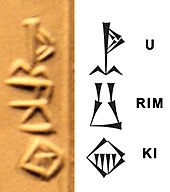
The name 𒋀𒀊𒆠 URIMv KI for "Country of Ur" on a seal of King Ur-Nammu
Ur was surrounded by sloping ramparts 8 metres (26 anxiety) high and about 25 metres (82 anxiety) broad, bordered in some places by a brick wall. Elsewhere, buildings were integrated into the ramparts. The Euphrates River complemented these fortifications on the city's western side.[seven]
Order and culture [edit]
Archaeological discoveries have shown unequivocally that Ur was a major Sumerian urban centre on the Mesopotamian plain. Peculiarly the discovery of the Majestic Tombs has confirmed its splendour. These tombs, which date to the Early on Dynastic IIIa period (approximately in the 25th or 24th century BC), contained an immense treasure of luxury items made of precious metals and semi-precious stones imported from long distances (Ancient Iran, Afghanistan, India, Asia Minor, the Levant and the Persian Gulf).[half dozen] This wealth, unparalleled upwardly to then, is a testimony of Ur's economical importance during the Early on Bronze Age.[8]
Archaeological report of the region has contributed greatly to our understanding of the landscape and long-altitude interactions during these ancient times. Ur was a major port on the Persian Gulf, which extended much farther inland than today, and the city controlled much of the trade into Mesopotamia. Imports to Ur came from many parts of the world: precious metals such equally gold and argent, and semi-precious stones, namely lapis lazuli and carnelian.[7]
It is thought that Ur had a stratified social arrangement including slaves (captured foreigners), farmers, artisans, doctors, scribes, and priests. Loftier-ranking priests apparently enjoyed great luxury and splendid mansions. Tens of thousands of cuneiform texts have been recovered from temples, the palace, and individual houses, recording contracts, inventories, and court documents, evidence of the city'south complex economic and legal systems.[7]
Music [edit]

Enthroned King Ur-Nammu (c. 2047–2030 BC)
Excavation in the sometime city of Ur in 1929 revealed lyres, instruments like to the mod harp just in the shape of a bull and with eleven strings.[ix]


The Standard of Ur mosaic, from the royal tombs of Ur, is made of cherry-red limestone, bitumen, lapis lazuli, and vanquish. The "peace" side shows condolement, music, and prosperity.The "war" side of the Standard of Ur shows the king, his armies, and chariots trampling on enemies.
History [edit]
Prehistory [edit]
When Ur was founded, the Farsi Gulf's water level was two-and-a-half metres higher than today. Ur is therefore thought to take had marshy surroundings; irrigation would have been unnecessary, and the city'south evident canal system was probable used for transportation. Fish, birds, tubers, and reeds might have supported Ur economically without the need for an agricultural revolution sometimes hypothesized as a prerequisite to urbanization.[10] [11]
Archaeologists have discovered the evidence of an early occupation at Ur during the Ubaid period (c. 6500 to 3800 BC). These early levels were sealed off with a sterile deposit of soil that was interpreted by excavators of the 1920s as evidence for the Cracking Alluvion of the Book of Genesis and Epic of Gilgamesh. It is at present understood that the South Mesopotamian evidently was exposed to regular floods from the Euphrates and the Tigris rivers, with heavy erosion from water and wind, which may have given ascent to the Mesopotamian and derivative Biblical Great Inundation stories.[12] [13]
Sumerian occupation of the 4th millennium [edit]
The further occupation of Ur becomes articulate only during its emergence in the tertiary millennium BC (although it must already have been a growing urban center during the 4th millennium). As other Sumerians, the new settlers of Ur were a non-Semitic people who may have come from the east circa 3300 BC, and spoke a linguistic communication isolate.[14] [15] The third millennium BC is generally described as the Early Bronze Age of Mesopotamia, which ends approximately after the demise of the Third Dynasty of Ur in the 21st century BC.
Third millennium BC (Early Bronze Age) [edit]
There are various main sources informing scholars about the importance of Ur during the Early Bronze Historic period. The Beginning Dynasty of Ur seems to take had great wealth and power, as shown by the lavish remains of the Royal Cemetery at Ur. The Sumerian King List provides a tentative political history of aboriginal Sumer and mentions, amongst others, several rulers of Ur. Mesannepada is the beginning king mentioned in the Sumerian King List, and appears to accept lived in the 26th century BC. That Ur was an of import urban centre already then seems to exist indicated by a blazon of cylinder seal called the City Seals. These seals contain a set of proto-cuneiform signs which appear to be writings or symbols of the proper name of metropolis-states in ancient Mesopotamia. Many of these seals accept been found in Ur, and the name of Ur is prominent on them.[16] Ur came under the command of the Semitic-speaking Akkadian Empire founded by Sargon the Great between the 24th and 22nd centuries BC. This was a menses when the Semitic-speaking Akkadians, who had entered Mesopotamia in approximately 3000 BC, gained clout over the Sumerians, and indeed much of the ancient Near East.
-
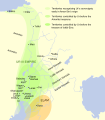
Empire of the Third Dynasty of Ur. West is at top, north at correct.
-
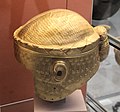
Gold helmet of King of Ur I Meskalamdug, c. 2600–2500 BC
-

Mesopotamian female person deity seated on a chair, Old-Babylonian fired clay plaque from Ur
Ur Three [edit]
Later a short menstruation of chaos post-obit the fall of the Akkadian Empire the 3rd Ur dynasty was established when the king Ur-Nammu came to power, ruling between c. 2047 BC and 2030 BC. During his rule, temples, including the Ziggurat of Ur, were built, and agronomics was improved through irrigation. His lawmaking of laws, the Lawmaking of Ur-Nammu (a fragment was identified in Istanbul in 1952) is i of the oldest such documents known, preceding the Lawmaking of Hammurabi by 300 years. He and his successor Shulgi were both deified during their reigns, and later his death he connected equally a hero-figure: one of the surviving works of Sumerian literature describes the death of Ur-Nammu and his journey to the underworld.[17]
Ur-Nammu was succeeded by Shulgi, the greatest king of the Tertiary Dynasty of Ur, who solidified the hegemony of Ur and reformed the empire into a highly centralized bureaucratic state. Shulgi ruled for a long time (at least 42 years) and deified himself halfway through his dominion.[18]
The Ur empire continued through the reigns of three more kings with Semitic Akkadian names,[12] Amar-Sin, Shu-Sin, and Ibbi-Sin. It fell around 1940 BC to the Elamites in the 24th regnal year of Ibbi-Sin, an event commemorated by the Lament for Ur.[nineteen] [20]
According to one judge, Ur was the largest city in the world from c. 2030 to 1980 BC. Its population was approximately 65,000 (or 0.1 per cent share of global population then).[21]
Later Bronze Age [edit]
The city of Ur lost its political power afterwards the demise of the Third Dynasty of Ur. Notwithstanding, its important position which kept on providing admission to the Persian Gulf ensured the ongoing economic importance of the urban center during the second millennium BC. The splendour of the city, the might of the empire, the greatness of king Shulgi, and undoubtedly the efficient propaganda of the state endured throughout Mesopotamian history. Shulgi was a well known historical figure for at to the lowest degree another two g years, while historical narratives of the Mesopotamian societies of Assyria and Babylonia kept names, events, and mythologies in remembrance. The city came to exist ruled by the first dynasty (Amorite) of Babylonia which rose to prominence in southern Mesopotamia in the 18th century BC. After the fall of Hammurabi's short lived Babylonian Empire, it later became a part of the native Akkadian ruled Sealand Dynasty for over 270 years, and was reconquered into Babylonia by the successors of the Amorites, the Kassites in the 16th century BC. During the Kassite Dynastic period Ur, along with the rest of Babylonia, came under sporadic control of the Elamites and the Middle Assyrian Empire, the latter of which straddled the Tardily Bronze Age and Early Iron Age periods betwixt the early 14th century BC and mid 11th century BC.[ citation needed ]
Iron Historic period [edit]
The metropolis, along with the rest of southern Mesopotamia and much of the Nigh East, Asia Pocket-sized, North Africa and southern Caucasus, fell to the northward Mesopotamian Neo-Assyrian Empire from the tenth to belatedly seventh centuries BC. From the end of the 7th century BC Ur was ruled by the and so-called Chaldean Dynasty of Babylon. In the 6th century BC there was new structure in Ur under the rule of Nebuchadnezzar 2 of Babylon. The terminal Babylonian rex, Nabonidus (who was Assyrian-built-in and not a Chaldean), improved the ziggurat. Nevertheless, the metropolis started to decline from around 530 BC after Babylonia brutal to the Persian Achaemenid Empire, and was no longer inhabited by the early on 5th century BC.[12] The demise of Ur was maybe attributable to drought, irresolute river patterns, and the silting of the outlet to the Farsi Gulf.
Identification with the Biblical Ur [edit]

"Abraham's Firm" in Ur, photographed in 2016
Ur is peradventure the city of Ur Kasdim mentioned in the Book of Genesis equally the birthplace of the Jewish, Christian and Muslim patriarch Abraham (Ibrahim in Arabic), traditionally believed to take lived some time in the 2nd millennium BC.[22] [23] [24] There are however conflicting traditions and scholarly opinions identifying Ur Kasdim with the sites of Şanlıurfa, Urkesh, Urartu or Kutha.
The biblical Ur is mentioned four times in the Torah or Onetime Testament, with the distinction "of the Kasdim/Kasdin"—traditionally rendered in English as "Ur of the Chaldees". The Chaldeans had settled in the vicinity past around 850 BC, just were not extant anywhere in Mesopotamia during the 2nd millennium BC flow when Abraham is traditionally held to accept lived. The Chaldean dynasty did not rule Babylonia (and thus become the rulers of Ur) until the tardily 7th century BC, and held ability simply until the mid sixth century BC. The proper name is institute in Genesis eleven:28,[25] Genesis 11:31,[26] and Genesis 15:seven.[27] In Nehemiah nine:seven, a single passage mentioning Ur is a paraphrase of Genesis. [28]
Archaeology [edit]

Bitumen "mortar" among Ur's mudbricks

Circular groups of bricks excavated in 1900
In 1625, the site was visited by Pietro Della Valle, who recorded the presence of ancient bricks stamped with foreign symbols, cemented together with bitumen, as well as inscribed pieces of blackness marble that appeared to exist seals. European archaeologists did not identify Tell el-Muqayyar equally the site of Ur until Henry Rawlinson successfully deciphered some bricks from that location, brought to England past William Loftus in 1849.[29]
The site was commencement excavated in 1853 and 1854, on behalf of the British Museum and with instructions from the Strange Office, past John George Taylor, British vice consul at Basra from 1851 to 1859.[30] [31] [32] Taylor uncovered the Ziggurat of Ur and a construction with an curvation later on identified as function of the "Gate of Judgment".[33]
In the four corners of the ziggurat'south meridian phase, Taylor establish clay cylinders bearing an inscription of Nabonidus (Nabuna`id), the terminal rex of Babylon (539 BC), closing with a prayer for his son Belshar-uzur (Bel-ŝarra-Uzur), the Belshazzar of the Book of Daniel. Evidence was establish of prior restorations of the ziggurat past Ishme-Dagan of Isin and Shu-Sin of Ur, and by Kurigalzu, a Kassite king of Babylon in the 14th century BC. Nebuchadnezzar also claims to have rebuilt the temple.[34]
Taylor further excavated an interesting Babylonian building, not far from the temple, part of an ancient Babylonian necropolis. All about the metropolis he found abundant remains of burials of later periods. Obviously, in subsequently times, owing to its sanctity, Ur became a favorite place of sepulchres, then that even after it had ceased to exist inhabited, it connected to be used as a necropolis.[34] Typical of the era, his excavations destroyed information and exposed the tell. Natives used the at present loosened, four,000-year-quondam bricks and tile for construction for the next 75 years, while the site lay unexplored,[35] the British Museum having decided to prioritize archæology in Assyria.[33]
After Taylor'southward time, the site was visited by numerous travellers, almost all of whom take plant aboriginal Babylonian remains, inscribed stones and the like, lying upon the surface.[34] The site was considered rich in remains, and relatively like shooting fish in a barrel to explore. After some soundings were fabricated in 1918 past Reginald Campbell Thompson, H. R. Hall worked the site for one season for the British Museum in 1919, laying the groundwork for more than extensive efforts to follow.[36] [37]

Aerial photograph of Ur in 1927
Excavations from 1922 to 1934 were funded past the British Museum and the University of Pennsylvania and led past the archaeologist Sir Charles Leonard Woolley.[38] [35] [39] A total of almost ane,850 burials were uncovered, including 16 that were described as "royal tombs" containing many valuable artifacts, including the Standard of Ur. Nearly of the regal tombs were dated to virtually 2600 BC. The finds included the unlooted tomb of a queen thought to be Queen Puabi[40]—the name is known from a cylinder seal institute in the tomb, although in that location were 2 other different and unnamed seals found in the tomb. Many other people had been cached with her, in a form of man sacrifice.[41] Nigh the ziggurat were uncovered the temple East-nun-mah and buildings E-dub-lal-mah (built for a king), E-gi-par (residence of the high priestess) and Due east-hur-sag (a temple building). Outside the temple area, many houses used in everyday life were constitute. Excavations were also fabricated below the regal tombs layer: a 3.v-metre-thick (11 ft) layer of alluvial clay covered the remains of earlier habitation, including pottery from the Ubaid period, the first phase of settlement in southern Mesopotamia. Woolley later wrote many articles and books about the discoveries.[42] One of Woolley's assistants on the site was the archeologist Max Mallowan.
The discoveries at the site reached the headlines in mainstream media in the world with the discoveries of the Royal Tombs. As a upshot, the ruins of the ancient urban center attracted many visitors. 1 of these visitors was the already famous Agatha Christie, who every bit a result of this visit concluded up marrying Max Mallowan.[43] [44] During this time the site was attainable from the Baghdad–Basra railway, from a cease called "Ur Junction".[45]
In 2009, an agreement was reached for a articulation University of Pennsylvania and Iraqi squad to resume archaeological work at the site of Ur.[46] Excavations began in 2015 nether the management of Elizabeth C Rock and Paul Zimansky of the State University of New York. The first excavation season was primarily to re-excavate Woolley'due south piece of work in an Sometime Babylonian housing area with 2 new trenches for confirmation. Amidst other finds a cylinder seal, a cuneform tablet, and residue pan weights were found. A similar though smaller dig was made in a Neo-Babylonian housing area. [47]
The Royal Tomb Excavation [edit]
When the Royal Tombs at Ur were offset discovered, they had no idea how big they were. They started by excavation two trenches in the middle of the desert to see if they could discover annihilation that would allow them to go along earthworks. They originally split into two teams. Team A and squad B. Both teams spent the first few months digging a trench and had plant evidence of burial grounds by collecting small pieces of gold jewelry and pottery. This was called at the fourth dimension the "gilt trench". At this time, the first season of excavation had come to a close, and Woolley returned to England. In Fall, Woolley returned and continued to dig into the 2nd season. Past the end of the 2nd season, he had uncovered a courtyard surrounded past many rooms.[48] In their tertiary season of digging they had uncovered their biggest notice all the same, a building that was believed to accept been congenital past the orders of the male monarch, and the 2d building to exist where the high priestess lived. As the fourth and fifth season came to a close, they had discovered then many items that most of their time was now spent recording the objects they institute instead of really digging objects.[49] They had found many items from aureate jewelry to dirt pots and stones. One of the almost significant objects that was discovered was the Standard of Ur. At the end of their 6th flavour they had excavated 1850 burials and deemed 17 of them to be "Royal Tombs".[50] A number of clay sealings and cuneiform tablet fragment were found in an underlying layer.[51]
Woolley finished his piece of work excavating the Royal Tombs in 1934, uncovering a series of burials. Many servants were killed and buried with the royals, who he believed went to their deaths willingly. Computerized tomography scans on some of the surviving skulls accept showed signs that they were killed by blows to the caput that could be from the spiked end of a copper axe, which showed Woolley'southward initial theory of mass suicide via poison to be incorrect.[52]
Within Puabi'south tomb at that place was a breast in the center of the room. Underneath that chest was a pigsty in the basis that led to what was called the "King's Grave": PG-789. It was believed to exist the king's grave considering it was buried next to the queen. In this grave, at that place were 63 attendants who were all equipped with copper helmets and swords. It is thought to be his army buried with him. Another big room was uncovered, PG-1237, called the "Great death pit".[53] This large room had 74 bodies, 68 of which were women. There were only two artifacts in the tomb, both of which were Lyres.[ citation needed ]
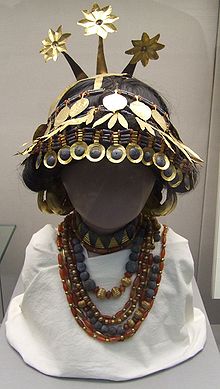
Reconstructed Sumerian headgear and necklaces found in the tomb of Puabi in the "Royal tombs" of Ur.
About of the treasures excavated at Ur are in the British Museum, the University of Pennsylvania Museum of Archæology and Anthropology and the Baghdad Museum. At the Penn Museum the exhibition "Iraq's Ancient By",[54] which includes many of the most famous pieces from the Royal Tombs, opened to visitors in late Leap 2011. Previously, the Penn Museum had sent many of its best pieces from Ur on tour in an exhibition called "Treasures From the Majestic Tombs of Ur." It traveled to 8 American museums, including those in Cleveland, Washington and Dallas, catastrophe the tour at the Detroit Institute of Fine art in May 2011.[ citation needed ]
Archaeological remains [edit]

Though some of the areas that were cleared during modern excavations accept sanded over over again, the Great Ziggurat is fully cleared and stands as the best-preserved and nearly visible landmark at the site.[55] The famous Royal tombs, also called the Neo-Sumerian Mausolea, located about 250 metres (820 ft) due south-east of the Slap-up Ziggurat in the corner of the wall that surrounds the metropolis, are almost totally cleared. Parts of the tomb area appear to be in need of structural consolidation or stabilization.[ citation needed ]
There are cuneiform (Sumerian writing) on many walls, some entirely covered in script stamped into the mud-bricks. The text is sometimes hard to read, just it covers most surfaces. Modern graffiti has likewise institute its way to the graves, unremarkably in the form of names made with coloured pens (sometimes they are carved). The Great Ziggurat itself has far more graffiti, mostly lightly carved into the bricks. The graves are completely empty. A small number of the tombs are accessible. Almost of them take been cordoned off. The whole site is covered with pottery debris, to the extent that information technology is virtually incommunicable to prepare pes anywhere without stepping on some. Some have colours and paintings on them. Some of the "mountains" of cleaved pottery are debris that has been removed from excavations. Pottery droppings and homo remains form many of the walls of the royal tombs area. In May 2009, the United States Army returned the Ur site to the Iraqi authorities, who promise to develop information technology as a tourist destination.[56]
Preservation [edit]

Since 2009, the non-profit organization Global Heritage Fund (GHF) has been working to protect and preserve Ur confronting the bug of erosion, neglect, inappropriate restoration, war and disharmonize. GHF's stated goal for the projection is to create an informed and scientifically grounded Master Program to guide the long-term conservation and management of the site, and to serve every bit a model for the stewardship of other sites.[57]
Since 2013, the institution for Development Cooperation of the Italian Ministry of Strange Affairs DGCS[58] and the SBAH, the State Board of Antiquities and Heritage of the Iraqi Ministry of Tourism and Antiquities, have started a cooperation project for "The Conservation and Maintenance of Archaeological site of UR". In the framework of this cooperation agreement, the executive plan, with detailed drawings, is in progress for the maintenance of the Dublamah Temple (pattern concluded, works starting), the Royal Tombs—Mausolea third Dynasty (in progress)—and the Ziqqurat (in progress). The beginning updated survey in 2013 has produced a new aeriform map derived by the flight of a UAV (unmanned aerial vehicle) operated in March 2014. This is the commencement high-resolution map, derived from more than 100 aeriform photograms, with an accurateness of xx cm or less. A preview of the ORTHO-PHOTOMAP of Archaeological Site of UR is available online.[59]
Tal Abu Tbeirah [edit]
Since 2012, a articulation squad of Italian and Iraqi archaeologists led by Franco D'Agostino accept been excavating at Tal Abu Tbeirah, located 15 kilometers e of Ur and 7 kilometers south of Nasariyah (30° 98′ 43.93′′ E, 46° 26′ 97.35′′ N).[60] [61] [62] [63] The site, about 45 hectares in expanse, appears to have been a harbor and trading center associated with Ur in the later half of the tertiary Millennium BC.[64] Amidst the finds was a large perforated potter'due south wheel and ii bricks inscribed with the proper name of Ur III king Amar-Sin.[65]
See likewise [edit]
- Correspondence of the Kings of Ur
- History of Iraq
- History of Sumer
- List of cities of the ancient Nigh East
- Lyres of Ur
- Ram in a Thicket
- Purple Game of Ur
- Short chronology
References [edit]
Notes:
- ^ Due south. N. Kramer (1963). The Sumerians, Their History, Culture, and Character. University of Chicago Press, pages 28 and 298.
- ^ Literal transliteration: Urim2 = ŠEŠ. ABgunu = ŠEŠ.UNUG (𒋀𒀕) and Urim5 = ŠEŠ.AB (𒋀𒀊), where ŠEŠ=URI3 (The Electronic Text Corpus of Sumerian Literature.)
- ^ The Cambridge Ancient History: Prolegomena & Prehistory. Vol. i, Office ane. p. 149. Accessed xv Dec 2010.
- ^ Tell el-Muqayyar in Arabic Tell ways "mound" or "hill" and Muqayyar means "congenital of bitumen." Muqayyar is variously transcribed as Mugheir, Mughair, Moghair, etc.
- ^ a b Erich Ebeling, Bruno Meissner, Dietz Otto Edzard (1997). Meek – Mythologie. Reallexikon der Assyriologie. (in German) p. 360 (of 589 pages). ISBN 978-3-11-014809-ane.
- ^ a b Zettler, R. L.; Horne, L., eds. (1998), Treasures from the Majestic Tombs of Ur, University of Pennsylvania Museum of Archaeology and Anthropology
- ^ a b c d Joan Goodnick Westenholz (1996), "Ur – Uppercase of Sumer", Purple Cities of the Biblical Earth, Jerusalem: Bible Lands Museum, ISBN965-7027-01-2
- ^ Aruz, J., ed. (2003), Fine art of the Kickoff Cities. The Third Millennium B.C. from the Mediterranean to the Indus, New York, the United statesA.: The Metropolitan Museum of Art
- ^ Galpin, F. W. (1929). "The Sumerian Harp of Ur, c. 3500 B. C." Music & Messages. Oxford University Press. 10 (2): 108–123. ISSN 0027-4224. Retrieved 25 February 2022.
- ^ Jennifer R. Pournelle, "KLM to CORONA: A Bird'south Centre View of Cultural Ecology and Early on Mesopotamian Urbanization"; in Settlement and Club: Essays Defended to Robert McCormick Adams ed. Elizabeth C. Rock; Cotsen Institute of Archaeology, UCLA, and Oriental Institute of the Academy of Chicago, 2007.
- ^ Crawford 2015, p. 5.
- ^ a b c Georges Roux – Ancient Iraq
- ^ "Secrets of Noah'south Ark - Transcript". Nova. PBS. 7 October 2015. Retrieved 27 May 2019.
- ^ "The Sumerians, a non-Semitic people who perhaps came from the eastward" in Curtis, Adrian (2009). Oxford Bible Atlas. Oxford Academy Press. p. 16. ISBN9780191623325. . Mention of Gen 11:2 "And as people migrated from the e, they establish a plain in the state of Shinar and settled there." (English Standard Version)
- ^ Bromiley, Geoffrey W. (1979). The International Standard Bible Encyclopedia. Wm. B. Eerdmans Publishing. p. 392. ISBN9780802837813.
- ^ Matthews, R.J. (1993). Cities, Seals and Writing: Primitive Seal Impressions from Jemdet Nasr and Ur, Berlin.
- ^ Amélie Kuhrt (1995). The Aboriginal Near East: C.3000-330 B.C. Routledge. ISBN 0-415-16762-0.
- ^ Potts, D. T. (1999). The Archeology of Elam. Cambridge, Britain: Cambridge Academy Press. p. 132. ISBN0-521-56496-iv . Retrieved 16 May 2015.
- ^ Ur Iii Menses (2112–2004 BC) by Douglas Frayne, Academy of Toronto Press, 1997, ISBN 0-8020-4198-i
- ^ Dahl, Jacob Lebovitch (2003). The ruling family of Ur Iii Umma. A Prosopographical Analysis of an Elite Family in Southern Republic of iraq 4000 Years agone (PDF). UCLA dissertation. Archived from the original (PDF) on 2006-05-12.
- ^ "What Were the Largest Cities Throughout History?". Geography.nearly.com . Retrieved 11 August 2017.
- ^ Salaheddin, Sinan (April 4, 2013). "Habitation of Abraham, Ur, unearthed by archaeologists in Republic of iraq". The Christian Scientific discipline Monitor . Retrieved July 15, 2017.
- ^ McLerran, Dan (June 23, 2011). "Birthplace of Abraham Gets a New Charter on Life". Popular Archaeology. iii . Retrieved July 15, 2017.
- ^ "Journey of Religion". National Geographic Magazine. May 15, 2012. Retrieved July 15, 2017.
- ^ Genesis 11:28
- ^ Genesis eleven:31
- ^ Genesis xv:7
- ^ Nehemiah 9:vii
- ^ Crawford 2015, p. iii.
- ^ J.East. Taylor, "Notes on the Ruins of Muqeyer", Journal of the Imperial Asiatic Order of Bully U.k. and Ireland, vol. xv, pp. 260–276, 1855.
- ^ JE Taylor, "Notes on Abu Shahrein and Tel-el-Lahm", Journal of the Majestic Asiatic Social club of United kingdom and Ireland, vol. xv, pp. 404–415, 1855. [In the relevant publications he is erroneously listed as J. East. Taylor].
- ^ E. Sollberger, "Mr. Taylor in Chaldaea", Anatolian Studies, vol. 22, pp. 129–139, 1972.
- ^ a b Crawford 2015, p. 4.
- ^ a b c Peters, John Punnett (1911). . In Chisholm, Hugh (ed.). Encyclopædia Britannica. Vol. 27 (11th ed.). Cambridge University Press. pp. 783–784.
- ^ a b Leonard Woolley, Excavations at Ur: A Tape of Twelve Years' Piece of work, Apollo, 1965, ISBN 0-8152-0110-9.
- ^ H. R. Hall, "The Excavations of 1919 at Ur, el-'Obeid, and Eridu, and the History of Early on Babylonia", Man, Royal Anthropological Plant of Cracking Great britain and Republic of ireland, Vol. 25, pp. 1–seven, 1925.
- ^ H. R. Hall, "Ur and Eridu: The British Museum Excavations of 1919", Periodical of Egyptian Archaeology, vol. 9, no. 3/4, pp. 177–195, 1923.
- ^ Leonard Woolley, Ur: The First Phases, Penguin, 1946.
- ^ Leonard Woolley and P. R. S. Moorey, Ur of the Chaldees: A Revised and Updated Edition of Sir Leonard Woolley's Excavations at Ur, Cornell University Press, 1982, ISBN 0-8014-1518-7.
- ^ Queen Puabi is too written Pu-Abi and formerly transcribed as Shub-ab.
- ^ Zimmerman, Paul C. (2021). 2 Tombs or Three? PG 789 and PG 800 Once more! (PDF). Studies in Ancient Oriental Civilization 71. Chicago: The Oriental Institute. pp. 283–296. ISBN978-ane-61491-063-3.
- ^ Brook, Roger B.; Linda Blackness; Larry S. Krieger; Phillip C. Naylor; Dahia Ibo Shabaka (1999). World History: Patterns of Interaction . Evanston, IL: McDougal Littell. ISBN0-395-87274-X.
- ^ Brunsdale, Mitzi K. (26 July 2010). Icons of Mystery and Crime Detection: From Sleuths to Superheroes [two volumes]. ABC-CLIO. p. 143. ISBN978-0-313-34531-9 . Retrieved 25 February 2022.
- ^ "The Globe This Weekend - Sir Max Mallowan". BBC Archive . Retrieved 25 February 2022.
- ^ Crawford 2015. p. v. "It used to exist shut to the Basra to Baghdad railway, part of the proposed Berlin to Basra line that was never completed. It was possible to get off the train from Baghdad at the grandly named Ur Junction, where a branch line turned off to Nasariyah, and bulldoze a mere 2 miles across the desert to the site itself, but the station was closed former after the Second Earth State of war, leaving a long, hot journey in a iv-wheeled vehicle as the merely option."
- ^ Radio Gratuitous Europe / Radio Liberty – Free Media in Unfree Societies U.S. Archaeologists To Excavate In Republic of iraq
- ^ Stone, Elizabeth C; Zimansky, Paul, Archæology Returns to Ur: A New Dialog with Onetime Houses, Near Eastern Archæology; Chicago, vol. 79, iss. 4, pp. 246-259 Dec 2016
- ^ "The Royal Tombs of Ur – Story". Mesopotamia.co.uk . Retrieved 2016-12-04 .
- ^ Hauptmann, Andreas, Klein, Sabine, Paoletti, Paola, Zettler, Richard 50. and Jansen, Moritz. "Types of Gilded, Types of Silvery: The Composition of Precious Metal Artifacts Found in the Majestic Tombs of Ur, Mesopotamia" Zeitschrift für Assyriologie und vorderasiatische Archäologie, vol. 108, no. 1, 2018, pp. 100-131
- ^ Royal Tombs
- ^ Benati, Giacomo and Lecompte, Camille. "From Field Cards to Cuneiform Athenaeum: Two Inscribed Artifacts from Archaic Ur and Their Archaeological Context" Zeitschrift für Assyriologie und vorderasiatische Archäologie, vol. 106, no. ane, 2016, pp. 1-15
- ^ McCorriston Joy, Field Julie (2019). World Prehistory and the Anthropocene An Introduction to Human History. New York: Thames & Hudson Inc. pp. 286–287. ISBN978-0-500-843185.
- ^ Great expiry pit
- ^ "Iraq'southward Ancient By: Rediscovering Ur's Royal Cemetery". Penn.museum . Retrieved xi August 2017.
- ^ "Soldiers visit historical ruins of Ur", Nov 18, 2009, past 13th Sustainment Command Expeditionary Public Affairs, web: Army-595.
- ^ "United states of america returns Ur, birthplace of Abraham, to Iraq". AFP. 2009-05-xiv. Retrieved 2009-09-12 .
- ^ Ur perservation project at the Global Heritage Fund
- ^ Italian Ministry of Foreign Affairs DGCS Ur funding
- ^ UAV aeriform Ur Photograph
- ^ Franco D'Agostino et al, ABU TBEIRAH. PRELIMINARY Study OF THE FIRST Campaign (JANUARY-MARCH 2012), Rivista degli studi orientali, Nuova Serie, vol. 84, Fasc. 1/4, pp. 17–34, 2011
- ^ Franco D'Agostino et al, Abu Tbeirah. Preliminary report of the 2nd entrada (Oct–Dec 2012), Rivista degli studi orientali, vol. 86(1), pp. 69–91, 2013
- ^ Franco D'Agostino et al, Abu Theirah, Nasiriyah (Southern Iraq): Preliminary report on the 2013 excavation entrada, ISIMU xiii, pp. 209–221, 2011
- ^ Licia Romano and Franco D'Agostino, Abu Tbeirah Excavations I. Area 1: Last Phase and Building A – Phase i, Sapienza Università Editrice, Jun 7, 2019 ISBN 9788893771085 [1]
- ^ Archaeologists Glance Into Trick Burrow in Iraq, Find 4,000-year-old Sumerian Port
- ^ Romano, Licia. "A Fragment of a Potter's Cycle from Abu Tbeirah" Zeitschrift für Assyriologie und vorderasiatische Archäologie, vol. 105, no. 2, 2015, pp. 220-234.
Bibliography:
- Black, J. and Spada, One thousand., "Texts from Ur: Kept in the Iraq Museum and the British Museum.", Nisaba 19, Messina: Dipartimento di Scienze dell'Antichitá 2008
- Crawford, Harriet. Ur: The City of the Moon God. London: Bloomsbury, 2015. ISBN 978-1-47252-419-v
- D'Agostino, F., Pomponio, F., and Laurito, R., "Neo-Sumerian Texts from Ur in the British Museum.", Nisaba 5, Messina: Dipartimento di Scienze dell'Antichitá, 2004
- Grant Frame, Joshua Jeffers and Holly Pittman ed., "Ur in the 20-First Century CE", "Proceedings of the 62nd Rencontre Assyriologique Internationale at Philadelphia, July 11–xv, 2016", Penn State University Press, 2021 ISBN 9781646021512
- C. J. Gadd. History and monuments of Ur, Chatto & Windus, 1929 (Dutton 1980 reprint: ISBN 0-405-08545-one).
- P. R. South. Morrey. "Where Did They Bury the Kings of the IIIrd Dynasty of Ur?", Iraq, vol. 46, no. ane, pp. 1–18, 1984.
- P.R.South. Morrey. "What Do We Know Nearly the People Cached in the Regal Cemetery?", Expedition Magazine, Penn Museum, vol. xx, iss. 1, pp. 24–40, 1977
- J. Oates, "Ur and Eridu: The Prehistory", Iraq, vol. 22, pp. 32–50, 1960.
- Pardo Mata, Pilar, "Ur, ciudad de los sumerios". Cuenca: Alderaban, 2006. ISBN 978-84-95414-38-0.
- Susan Pollock, "Chronology of the Purple Cemetery of Ur", Republic of iraq, vol. 47, pp. 129–158, British Institute for the Study of Republic of iraq, 1985
- Susan Pollock, "Of Priestesses, Princes and Poor Relations: The Dead in the Imperial Cemetery of Ur", Cambridge Archaeological Journal, vol. 1, iss. two, 1991
- Licia Romano and Franco D'Agostino, "Abu Tbeirah Excavations I. Area 1: Concluding Phase and Building A – Phase 1", Sapienza Università Editrice, Jun 7, 2019, ISBN 9788893771085
- [2] Leon Legrain, "Ur Excavations III: Primitive seal-impressions", Publications of the Joint Expedition of the British Museum and of the University Museum, Academy of Pennsylvania, Philadelphia, to Mesopotamia : Ur excavations, Oxford University Press, 1936
- [iii]Woolley, Leonard, "Ur Excavations Two. The Majestic Cemetery", Plates, Publications of the Articulation Trek of the British Museum and of the Academy Museum, University of Pennsylvania, Philadelphia, to Mesopotamia : Ur excavations, Oxford University Press, 1927
- Ur excavations IV: The Early Periods, Oxford University Press, 1927.
- Ur Excavations V: The Ziggurat and Its Environs, Oxford Academy Press, 1927.
- with M.Due east.L. Mallowan (ed. T. C. Mitchell): Ur Excavations Seven: The Old Babylonian Catamenia, Oxford Academy Press, 1927
- (ed. T. C. Mitchell), Ur Excavations VIII: The Kassite Period, Oxford University Press, 1927
- with Yard.E.Fifty. Mallowan (ed. T. C. Mitchell),: Ur Excavations IX: The Neo-Babylonian and Western farsi Periods, Oxford University Press, 1927
- Ur of the Chaldees: A record of seven years of excavation. Ernest Benn Limited, 1920.
External links [edit]
 | Wikimedia Eatables has media related to Ur. |
 | Wikiquote has quotations related to: Ur |
- Metropolis of the Moon New Excavations at Ur - Penn Museum - 2017
- An exploration of the Imperial Tombs of Ur, with a comprehensive selection of high-resolution photographs detailing the treasures found in the tombs
- Explore some of the Royal Tombs, Mesopotamia website from the British Museum
- Treasures from the Royal Tombs of Ur
- British Museum and Penn Museum Ur site – has field reports
- Jewish Encyclopedia: Ur
- Woolley's Ur Revisited, Richard L. Zettler, BAR ten:05, September/October 1984.
- Ur Excavations of the University of Pennsylvania Museum
- At Ur, Ritual Deaths That Were Anything just Serene on The New York Times
- Spider web site for new Iraqi/Italian dig
Source: https://en.wikipedia.org/wiki/Ur
0 Response to "This Fertile Land Signs and Symbols in the Early Arts of Iran and Iraq"
Post a Comment