If the President Is Impeached Can He Run for Office Again
The Causes for Which a President Can Be Impeached
"What, then, is the meaning of 'high crimes and misdemeanors,' for which a President may exist removed? Neither the Constitution nor the statutes have determined."
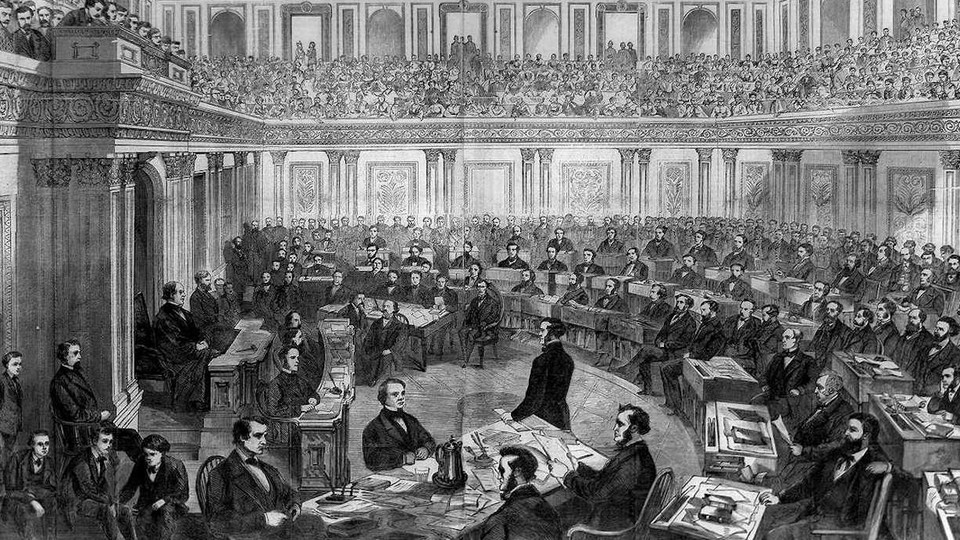
The Constitution provides, in express terms, that the President, besides as the Vice-President and all civil officers, may be impeached for "treason, blackmail, or other loftier crimes and misdemeanors." Information technology was framed by men who had learned to their sorrow the falsity of the English maxim, that "the king tin can practise no incorrect," and established by the people, who meant to agree all their public servants, the highest and the everyman, to the strictest accountability. All were jealous of any "squinting towards monarchy," and determined to allow to the primary magistrate no sort of regal amnesty, only to secure his faithfulness and their ain rights past holding him personally accountable for his misconduct, and to protect the authorities past making acceptable provision for his removal. Moreover, they did not mean that the door should not be locked till after the horse had been stolen.
By the Constitution, the House of Representatives has "the sole power of impeachment," and the Senate "the sole power to endeavour all impeachments." When the President of the United States is tried on impeachment, the Chief Justice is to preside. The concurrence of two thirds of the members present is necessary to convict. "The President, Vice-President, and all civil officers of the United States, shall be removed from part on impeachment for, and conviction of, treason, blackmail, or other high crimes and misdemeanors." Merely judgment cannot "extend further than to removal and disqualification to hold and relish and office of honor, trust, or profit under the Us." Thus it is obvious that the founders of the government meant to secure it effectually confronting all official corruption and incorrect, past providing for procedure to be initiated at the will of the popular branch, and furnishing an easy, safe, and sure method for the removal of all unworthy and unfaithful servants.
By defining treason exactly, past prescribing the precise proofs, and limiting the punishment of it, they guarded the people confronting i form of tyrannical abuse of ability; and they intended to secure them effectually against all injury from abuses of another sort, past holding the President responsible for his "misdemeanors," — using the broadest term. They guarded advisedly against all danger of popular excesses, and any injustice to the accused, by withholding the general power of penalization. This term "misdemeanor," therefore, should be liberally construed, for the same reason that treason should not be extended past construction. It is not amend for the state that traitors should remain in office than that innocent men should be expelled. Besides, information technology is true in relation to this procedure, that the higher the post the college the crime.
What, then, is the meaning of "loftier crimes and misdemeanors," for which a President may exist removed? Neither the Constitution nor the statutes have determined. Information technology follows, therefore, that the Business firm must judge for what offences it will present manufactures, and the Senate determine for what it will convict. And from the very nature of the wrongs for which impeachment is the sole adequate remedy, as well as from the fact that the role of President and all its duties and relations are new, it is essential that they should be undefined; otherwise there could be no security for the country.
Just information technology does not by whatever means follow that therefore either the House or the Senate can human action arbitrarily, or that there are not rules for the guidance of their conduct. The terms "high crimes and misdemeanors," like many other terms and phrases used in the Constitution, as, for example, "pardon," "habeas corpus," "ex post facto," and the term "impeachment" itself, had a settled meaning at the fourth dimension of the establishment of the Constitution. In that location was no need of definition, for information technology was left to the House every bit exhibitors, and the Chief Justice and the Senate as judges of the articles, to utilize well-understood terms, mutatis mutandis, to new circumstances, as the exigencies of state, and the ends for which the Constitution was established, should crave. The discipline-affair was new; the President was a new officer of state; his duties, his relations to the various branches of regime and to the people, his powers, his oath, functions, duties, responsibilities, were all new. In some respects, old customs and laws were a guide. In others, in that location was neither precedent nor analogy. But the common-law principle was to be practical to the new matters co-ordinate to their exigency, as the mutual law of contracts and of carriers is applied to carriage past steamboats and railroads, to corporations and expresses, which take come into being centuries since the police was established.
Impeachment, "the presentment of the most solemn grand inquest of the whole kingdom" had been in employ from the earliest days of the English Constitution and authorities.
The terms "high crimes and misdemeanors," in their natural sense, embrace a very large field of actions. They are wide enough to embrace all criminal misconduct of the President, — all acts of committee or omission forbidden by the Constitution and the laws. To the word "misdemeanor," indeed, is naturally attached a still broader signification, which would embrace personal character and behavior as well as the proprieties of official conduct. Nor was, nor is, in that location whatsoever simply reason why it should be restricted in this direction; for, in establishing a permanent national government, to insure purity and dignity, to secure the confidence of its own people and command the respect of foreign powers, it is non unfit that civil officers, and virtually especially the highest of all, the head of the people, should be answerable for personal demeanor.
The term "misdemeanor" was besides used to designate all legal offences lower than felonies, — all the small transgressions, all public wrongs, not felonious in character. The common law punished whatever acts were productive of disturbance to the public peace, or tended to incite to the commission of crime, or to injure the health or morals of the people, — such as profanity, drunkenness, challenging to fight, soliciting to the commission of crime, carrying infection through the streets, — an countless variety of offences.
These terms, when used to describe political offences, take a signification coextensive with, or rather analogous to, just yet more extensive than their legal acceptation; for, every bit John Quincy Adams said, "the Legislature was vested with ability of impeaching and removing for trivial transgressions below the cognizance of the police." The sense in which they are used in the Constitution is rendered clearer and more precise past the long line of precedents of decided cases to exist found in the Land Trials and historical collections. Selden, in his "Judicature of Parliament," and Coke, in his "Institutes," refer to many of these, and Comyns names more 50 impeachable offences. Amongst these are, subverting the central laws and introducing capricious power; for an ambassador to give false information to the male monarch; to make a treaty betwixt two strange powers without the cognition of the male monarch; to deliver up towns without consent of his colleagues; to incite the king to act confronting the advice of Parliament; to give the male monarch evil counsel; for the Speaker of the House of Eatables to refuse to proceed; for the Lord Chancellor to threaten the other judges to make them subscribe to his opinions.
Wooddeson, who began to lecture in 1777, and whose works express the sense in which the terms were understood by the contemporaries of the founders of the Constitution, says that "such kinds of misdeeds as peculiarly injure the republic by the abuses of high offices of trust are the most proper, and accept been the most usual grounds for this kind of prosecution"; — "every bit, for example, for the Lord Chancellor to deed grossly contrary to the duty of his office; for the judges to mislead the sovereign past unconstitutional opinions; for any other magistrates to attempt to subvert the fundamental laws, or introduce arbitrary ability, as for a Privy-Councillor to propose or back up pernicious or dishonorable practices."
These text-writers seem to accept been referred to and followed past our later ones.
Merely to the offences enumerated by these authorities we must add others taken from cases in the State Trials. The High Court of Impeachment had included amongst political high crimes and misdemeanors the post-obit, viz.: for a Secretary of Land to abuse the pardoning power; for the Lord Chancellor and Chief Justice of Ireland to attempt to subvert the laws and government and the rights of Parliament; for the Chaser-General to prefer charges of treason falsely; for a Privy-Councillor to attempt to alienate the affections of the people; for the Lord Chancellor to assume to dispense with the statutes, and to control them. Information technology had been held to be a misdemeanor to incite the king to ill-manners; to put away from the king good officers, and put about him wicked ones of their own party; to maintain robbers and murderers, causing the king to pardon them; to get ascendency over the king, and turn his center from the peers of the realm; to foreclose the cracking men of the realm from advising with the king, save in presence of the accused; and to cause the rex to appoint sheriffs named by them, so equally to go such men returned to Parliament equally they desired, to the undoing of the loyal lords and the good laws and community; to taunt the king'south councilors, and phone call them unworthy to sit in quango when they advised the king to reform the government; or to write messages declaring them traitors.
The nature of the charges may exist illustrated by one of the allegations confronting an evil gauge. We give Article 8.: "The said William Scroggs, being avant-garde to be Lord Chief Justice of the Court of King's Bench, ought, past a sober, grave, and virtuous conversation, to have given a expert example to the rex's liege people, and to demean himself answerable to the dignity of and so eminent a station; even so on the opposite thereof, he doth, past his frequent and notorious excesses and debaucheries, and his profane and atheistical discourses, affront Almighty God, dishonor his Majesty, give countenance and encouragement to all style of vice and wickedness, and bring the highest scandal on the public justice of the kingdom."
Such was the nature of political offences, every bit known to the framers of the Constitution. It answered to the natural sense of the terms of the Constitution, every bit understood past the people in establishing it. And it is patently that the founders of the government meant to establish, what in such a authorities is vital to the safety and stability of the state, a jurisdiction coextensive with the influence of the officers subjected to it, and with their official duties, their functions, and their public relations.
The Federalist, in treating of this jurisdiction of the Senate, regarded it as extending over "those offences which proceed from the misconduct of public men" and termed "political, as they relate chiefly to injuries washed immediately to club itself."
The people of America meant to rest their regime on executive responsibility, and to apply to the President the principles which had been established as applicative but to the ministers, servants, and advisers of the king. Only to prove what they regarded as the range of regal duty, they had put on record a list of charges against their ain rex himself, commencing thus: "He has refused his assent to laws the most wholesome and necessary for the public expert," — on which they justified revolution. The Declaration of Independence will assistance in determining what they would regard equally offences of the Executive.
No President has been impeached. But the charges exhibited against several other public officers throw light upon this subject. In 1797, articles of impeachment were plant against William Blount, a Senator. The misdemeanors were not charged as being done in the execution of whatever role under the United States. He was non charged with misconduct in function, merely with an attempt to influence a United States Indian interpreter, and to amerce the affection and conviction of the Indians. Subsequently the impeachment was known, simply before information technology was presented to the Senate, the Senate expelled him, resolving "that he was guilty of a high misdemeanor entirely inconsistent with his public trust and duty every bit a Senator."
In 1804, John Pickering, Judge of the District Court of New Hampshire, was removed for, — 1. Misbehavior every bit a estimate; and amid other causes, iv. For appearing drunk, and ofttimes, in a profane and indecent mode, invoking the proper name of the Supreme Beingness.
In 1804, Judge Hunt was impeached and tried for capricious, oppressive, and unjust conduct, in delivering his opinion on the law beforehand, and debarring counsel from arguing the constabulary; and for unjust, impartial, and intemperate behave in obliging counsel to reduce their statements to writing, the use of rude and contemptuous language, and intemperate and vexatious conduct.
These are cases of contemporaneous exposition. There take been other cases in the various States, and some more than recent ones in Congress; but they are not necessary to illustrate the subject. Just on the eve of the war, the Senate expelled Bright for writing a letter to Jefferson Davis, introducing a man with an improvement in fire-artillery as a reliable person.
As Judge Story remarked, "Political offences are of and then various and complex a graphic symbol, so utterly incapable of being defined or classified, that the job of positive legislation would be impracticable, if it were non almost absurd to effort it." Referring to the text-writers nosotros have named, and the causes of impeachment enumerated past them, he seems to justify the extremest cases past proverb that, though they now seem harsh and severe, "perhaps they were rendered necessary by existing corruptions and the importance of suppressing a spirit of favoritism and court intrigue." "But others again," he adds, "were founded in the nearly salutary public justice, such as impeachments for malversations and neglects in office, for official oppression, extortion, and deceit, and especially for putting expert magistrates out of function and advancing bad." He puts a case, on which he expresses no opinion, in such form that there tin can scarcely be any dubiety of his stance, or whatsoever possibility of two opinions concerning it. "Suppose a judge should countenance or aid insurgents in a meditated conspiracy or coup a meditated conspiracy or coup against the government. This is not a judicial act; and yet it ought certainly to exist impeachable."
Thus information technology appears that the political offences of the Constitution for which civil officers are removable embrace, besides the high crimes and misdemeanors of the criminal law, a range as wide equally the circle of official duties and the influences of official position; they include, not merely breaches of duty, just as well misconduct during the tenure of function; they extend to acts for which there is no criminal responsibleness whatsoever; they reach even personal conduct; they include, not only acts of usurpation, only all such acts every bit tend to subvert the just influence of official position, to degrade the office, to contaminate society, to impair the government, to destroy the proper relations of civil officers to the people and to the government, and to the other branches of the regime.
In fine, information technology may almost be said, that for a President to have done anything which he ought not to have done, or to have left undone anything which he ought to have done, is just crusade for his impeachment, if the House past a bulk vote feels called on to get in the footing of charges, and the Senate by a two-thirds vote determines it to be sufficient; for the safety of the state is the supreme law, and these bodies are the final judges thereof.
Source: https://www.theatlantic.com/magazine/archive/1867/01/the-causes-for-which-a-president-can-be-impeached/548144/
0 Response to "If the President Is Impeached Can He Run for Office Again"
Post a Comment